<?xml version="1.0" encoding="UTF-8"?>
<feed xmlns="http://www.w3.org/2005/Atom">
  <title type="text">DC Historic Sites</title>
  <updated>2026-03-25T12:52:49+00:00</updated>
  <generator uri="http://framework.zend.com" version="1.12.20">Zend_Feed_Writer</generator>
  <link rel="alternate" type="text/html" href="https://historicsites.dcpreservation.org/"/>
  <link rel="self" type="application/atom+xml" href="https://historicsites.dcpreservation.org/items/browse?output=rss2"/>
  <id>https://historicsites.dcpreservation.org/</id>
  <author>
    <name>DC Historic Sites</name>
    <uri>https://historicsites.dcpreservation.org</uri>
  </author>
  <link rel="hub" href="https://pubsubhubbub.appspot.com/"/>
  <entry>
    <title type="html"><![CDATA[Civil Rights Tour: Recreation - Anacostia Pool, Swimming for All: 1800 Anacostia Drive SE]]></title>
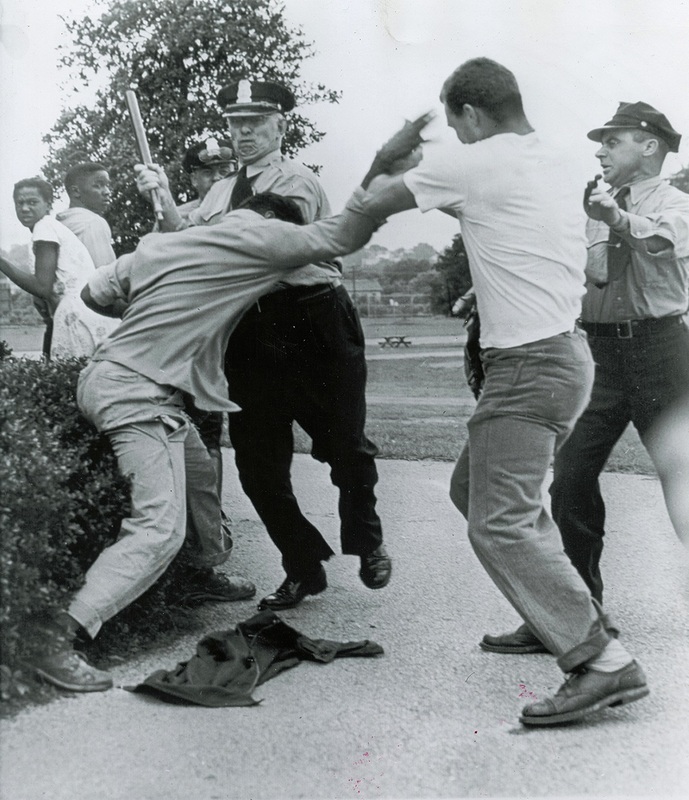
    <summary type="html"><![CDATA[<p><strong><em><div style="text-align:center;">As summer began in 1949, African American residents of far Northeast and Southeast looked forward to finally having access to a swimming pool on their side of the Anacostia River.</div></em></strong></p><img src="https://historicsites.dcpreservation.org/files/fullsize/00023406390194a0318b55e086c223c1.jpg" alt="In June 1949, after the federal government announced the desegregation of Anacostia Pool, racial violence broke out when black children entered the facility." /><br/><p>National Capital Parks (NCP), the federal entity that operated six of the city’s eight public pools, announced it would desegregate Anacostia Pool on June 23. But when African American children showed up to swim that day, they were met with threats by a group of white boys who surrounded them and drove them away.  </p><p>Similar confrontations over the next few days led to violence.  On June 29, police broke up a crowd at the pool site, making arrests for disorderly conduct and the distribution of anti-segregation flyers. The US Department of the Interior, which oversaw National Capital Parks, closed Anacostia Pool for the rest of the summer. </p><p>Historically, the District’s federal recreation facilities such as golf courses, certain parks, swimming pools, and tennis courts were officially open to everyone, but, by custom, whites claimed four of the federal pools (Anacostia, East Potomac Park, McKinley, Takoma), and relegated just two (Banneker and Francis) to African Americans.  Meanwhile, the DC Recreation Board refused to integrate any of its facilities, including most of the city’s playgrounds and its two whites-only pools (Georgetown and Rosedale). As a result, NCP retained control of its pools rather than transfer them to the DC Board of Recreation as planned.  Anacostia Pool re-opened on a non-segregated basis in 1950.</p><p>Because they were barred from public pools, many African American children never learned to swim. Between 1945 and 1948, 29 of 37 school-aged boys who drowned in the city were black.  At <a href="https://historicsites.dcpreservation.org/items/show/966">Rosedale Playground</a> in Kingman Park, the 1952 drowning of a teenager who had climbed the fence to swim sparked pickets and direct action by residents, leading the DC Department of Recreation to de-segregate Rosedale Pool that fall.</p><p><em><strong><a href="https://historicsites.dcpreservation.org/items/show/914">For more (including 2 images) view the original article</a></strong></em></p>]]></summary>
    <published>2018-12-20T01:30:58+00:00</published>
    <updated>2026-03-25T12:52:48+00:00</updated>
    <link rel="alternate" type="text/html" href="https://historicsites.dcpreservation.org/items/show/914"/>
    <id>https://historicsites.dcpreservation.org/items/show/914</id>
    <author>
      <name>DC Historic Preservation Office</name>
    </author>
  </entry>
  <entry>
    <title type="html"><![CDATA[Civil Rights Tour: Housing - Barry Farm Dwellings: Sumner, Eaton, Stevens and Wade roads SE]]></title>
    <summary type="html"><![CDATA[<p><strong><em><div style="text-align:center;">"They say we have outside agitators . . . . Heck, when you're living like this, you don’t need anybody from outside to agitate [for] you." </p><p>(<em>The Washington Post</em>, December 25, 1966).</div></em></strong></p><img src="https://historicsites.dcpreservation.org/files/fullsize/9924615a7a04d556ce3d4e470db56214.jpg" alt="Stokely Carmichael on Eaton Road in Barry Farm Dwellings at a rally in July 1966. Philip Perkins, a neighborhood worker for Southeast Neighborhood House is standing to his left." /><br/><p>Barry Farm Dwellings was just over 20 years old in 1966, and already falling apart when a <em>Washington Post</em> reporter interviewed residents for her article, "Hope Ebbs and Tempers Rise: Underground Poor Fight Funds Cuts." Driven by poor living conditions combined with constant harassment by welfare investigators in the 1960s, tenant activist Etta Horn went from organizing her neighbors at Barry Farms, as it became known, to becoming a leading national welfare rights activist. A neighbor of Horn's, quoted above, agreed that conditions were bad. Rats and cockroaches ran rampant, faucets leaked, and one resident's ceiling had crashed onto her stove. </p><p>Although the majority of the tenants at Barry Farm received government assistance, most could still barely afford to feed or clothe their families. They risked losing access to welfare benefits by taking jobs that paid even less, such as babysitting for a neighbor so they could go to work. Welfare investigators visited at all hours, entering without permission in search of boyfriends or husbands, whose presence could disqualify women from receiving public funds. From the perspective of Horn and her neighbors, the city directed more resources toward surveillance than it did toward basics such as maintaining furnaces and planting grass. </p><p>While public housing residents had endured such conditions for years, in February 1966 an infusion of federal dollars suddenly provided resources and funds for Barry Farms residents to organize. President Lyndon B. Johnson's War on Poverty, announced in 1964, called on "maximum feasible participation" by the poor and, via DC's United Planning Organization, directed funds to Anacostia's Southeast Neighborhood House to organize tenants. </p><p>The newly formed <em>Band of Angels</em>—an all-women tenant association—soon began picketing the city's welfare department and the Alexandria home of its director. <em>Rebels with a Cause</em>—comprising at least 250 young adults and teenagers—demanded improvements around Barry Farm Dwellings, from functional street lights to recreation facilities, job training, and responsive, respectful policing. Participants were coached by seasoned activists and attended seminars at the <a href="https://historicsites.dcpreservation.org/items/show/1010">Institute for Policy Studies</a> to hone their skills and network with grassroots leaders from other cities. Within a year, funds for fixing up Barry Farms were increased and re-allocated to essential needs, recreation programs were established, day care and job counseling were provided, and a black police captain was assigned to the local precinct.</p><p>As of 2019, Barry Farm Dwellings was partially demolished in preparation for redevelopment of the site.</p><p><em><strong><a href="https://historicsites.dcpreservation.org/items/show/915">For more (including 5 images) view the original article</a></strong></em></p>]]></summary>
    <published>2018-12-27T22:12:13+00:00</published>
    <updated>2026-03-25T12:52:48+00:00</updated>
    <link rel="alternate" type="text/html" href="https://historicsites.dcpreservation.org/items/show/915"/>
    <id>https://historicsites.dcpreservation.org/items/show/915</id>
    <author>
      <name>DC Historic Preservation Office</name>
    </author>
  </entry>
  <entry>
    <title type="html"><![CDATA[Civil Rights Tour: Civic and Social Life - Billy Simpson and the Ebony Table: 3813 Georgia Avenue NW]]></title>
    <summary type="html"><![CDATA[<p><strong><em><div style="text-align:center;">“Hardly anything of significance to Washington – and most particularly to black Washington – came to fruition without Billy Simpson’s significant – albeit non-public – role in it.”</div></em></strong></p><img src="https://historicsites.dcpreservation.org/files/fullsize/0203db0119b9bed2e12049c3de2c433d.jpg" alt="Billy Simpson’s House of Seafood and Steaks and the Ebony Table, the restaurant’s more formal and exclusive upstairs dining venue  " /><br/><p>So chronicled newspaper columnist William Raspberry upon the death of Billy Simpson (1914-1975), owner of Billy Simpson’s House of Seafood and Steaks. Indeed, between 1958 and his death, Billy Simpson and his restaurant played a central role in the social and political culture of the city, providing Washington’s African American community with an upscale venue not just for dining and socializing, but for strategizing on the political and civil rights events of the day. Simpson never ran for public office himself, but his influence was widespread. </p><p>As soon as it opened in 1956, the restaurant—with its Tudor half-timbering exterior—filled a void for African Americans who had few options for dining out. The restaurant became a popular meeting place for intellectuals, professionals, politicians, entertainers, and African diplomats who came to enjoy the elegant “white table-cloth service” on the restaurant’s first floor and its intimate Ebony Table bar on the second. In keeping with the medieval motif of the restaurant, Simpson established an informal “Round Table” where black Congressmen, journalists, and federal officials gathered. </p><p>Congressmen Charles C. Diggs and Adam Clayton Powell, Jr., were personal friends of Simpson’s, and regulars at the restaurant. Among other causes, Simpson—a life-long advocate for home rule for the District—actively supported the 1963 March on Washington for Jobs and Freedom, the 1968 Poor People’s Campaign (Jesse Jackson used the restaurant as his headquarters during the Campaign), and the anti-war movement. </p><p><a href="https://catalog.archives.gov/id/117692472">Billy Simpson’s House of Seafood and Steaks</a> was added to the National Register of Historic Places in 2009.</p><p><em><strong><a href="https://historicsites.dcpreservation.org/items/show/917">For more (including 3 images) view the original article</a></strong></em></p>]]></summary>
    <published>2018-12-28T00:19:28+00:00</published>
    <updated>2026-03-25T12:52:48+00:00</updated>
    <link rel="alternate" type="text/html" href="https://historicsites.dcpreservation.org/items/show/917"/>
    <id>https://historicsites.dcpreservation.org/items/show/917</id>
    <author>
      <name>DC Historic Preservation Office</name>
    </author>
  </entry>
  <entry>
    <title type="html"><![CDATA[Civil Rights Tour: Education - Browne Junior High, the Fight for School Desegregation: 850 26th Street NE]]></title>
    <summary type="html"><![CDATA[<p><strong><em><p style="text-align:center;">Marguerite Daisy Carr was only 13 years old in 1947 when she found herself at the center of a legal battle over equal education.</em></strong></p><img src="https://historicsites.dcpreservation.org/files/fullsize/89929471619fdecf68766b8bbcddde48.jpg" alt="Browne Junior High School (now Browne Middle School), 2015" /><br/><p>Carr’s school, Browne Junior High, had been built in 1932 for 888 students, but by 1941 it held close to twice that number. With class sizes ranging from 50 to 58 students, it was cited as the most overcrowded of the city’s public schools. The School Board responded by splitting students into morning and afternoon shifts; by 1947, as enrollment continued to grow, the board further reduced daily instruction to less than the six hours per day as required by DC law. Staff, parents and students, not only at Browne, but citywide, were outraged by the overcrowding and poor conditions of the city’s Black schools, many of which were housed in aging facilities that were passed down from the system’s white division.
Attorney Leon A. Ransom, former Acting Dean of Howard University Law School, petitioned Superintendent Hobart M. Corning and the School Board to allow Browne students, including Marguerite Carr, to enroll at Eliot Junior High—a nearby, under-enrolled school for white students. When Corning resisted, Ransom filed a legal complaint in October 1947. Marguerite and her father James C. Carr, Sr.—the new PTA president at Browne—became the lead plaintiffs in a lawsuit challenging segregation. 
Rather than allowing black students to attend a white school, the Board responded by annexing two nearby decommissioned white elementary schools to serve the Browne student body. But these outdated, “cast-off” schools lacked gyms, libraries, auditoriums, working cafeterias and even fully functioning restrooms, and required students to move between school buildings across a major road. In response, some 160 parents who would organize themselves as the Consolidated Parent Group announced a boycott on December 3, 1947; over the next three weeks, nearly all of the rest of Browne’s parents joined the strike. After truant officers visited their homes, attorney Charles Hamilton Houston persuaded the group’s leader, Gardner Bishop, to call off the boycott as a precondition for filing another suit on behalf of Bishop’s daughter Judine. Most of the Browne parents sent their children back to school in January. 
In 1950, an appeals court upheld segregation in <em>Carr v. Corning</em>, but Carr’s loss fueled the battle for integrated schools. Rather than fight for quality education under “separate but equal” schools, civil rights lawyers and activists now focused squarely on eliminating segregation altogether—a victory that would be celebrated four years later when the U.S. Supreme Court ruled in <em>Bolling v. Sharpe</em> and <em>Brown v. Board of Education</em> that segregated schools were unconstitutional. 
</p><p><em><strong><a href="https://historicsites.dcpreservation.org/items/show/918">For more (including 5 images) view the original article</a></strong></em></p>]]></summary>
    <published>2019-01-08T22:28:37+00:00</published>
    <updated>2026-03-25T12:52:48+00:00</updated>
    <link rel="alternate" type="text/html" href="https://historicsites.dcpreservation.org/items/show/918"/>
    <id>https://historicsites.dcpreservation.org/items/show/918</id>
    <author>
      <name>DC Historic Preservation Office</name>
    </author>
  </entry>
  <entry>
    <title type="html"><![CDATA[Civil Rights Tour: Protest - Ralph Bunche: 1510 Jackson Street NE]]></title>
    <summary type="html"><![CDATA[<p><strong><em><p style="text-align:center;">Ralph J. Bunche was among a group of young Howard University social scientists who focused on economic-based solutions for racial discrimination.</em></strong></p><img src="https://historicsites.dcpreservation.org/files/fullsize/977bbed559cc85243cc8bd9ebce3819b.jpg" alt="Ralph Bunche at the Los Angeles Airport, 1949" /><br/><p>Hired in 1926 by Mordecai Johnson, the university’s first black president, Ralph Bunche (1904-1971) established and chaired Howard’s Department of Political Science. He also advised a student group that went on to work with local churches and community organizations in forming a local chapter of the National Negro Congress (NNC). The NNC saw economic exploitation as central to white supremacy and organized boycotts, strikes, and marches across class lines. </p><p>In 1935, Bunche helped organize a protest against the white-owned <a href="https://historicsites.dcpreservation.org/items/show/956">National Theatre</a>’s policy of excluding African American audiences, resulting in a short-lived change in the theater’s policy. That same year, his students at Howard joined more than 100,000 other college students in a nationwide strike against war and fascism. </p><p>In 1941, Bunche, who had lived in several houses in the general vicinity of Howard University, commissioned noted African American architect <a href="https://historicsites.dcpreservation.org/items/show/988">Hilyard Robinson</a> to design a new house for him on Jackson Street in the quiet middle-class community of Brookland. Robinson had designed, two years earlier, a house for civil rights leader <a href="https://historicsites.dcpreservation.org/items/show/963">Rayford Logan</a> on the same block. Bunche lived in this house for six years until he accepted a position with the United Nations and he and his family moved to New York. </p><p>Bunche later enjoyed a long career in U.S. foreign affairs, with distinguished service to the United Nations from 1946 until 1970. In 1950, he became the first African American to receive the Nobel Peace Prize, which honored his efforts as a United Nations mediator between the Arab states and Israel in 1949. </p><p>Bunche was a speaker at the 1965 Selma to Montgomery march led by the Reverend Dr. Martin Luther King, Jr.</p><p><em><strong><a href="https://historicsites.dcpreservation.org/items/show/919">For more (including 4 images) view the original article</a></strong></em></p>]]></summary>
    <published>2019-01-08T23:04:28+00:00</published>
    <updated>2026-03-25T12:52:48+00:00</updated>
    <link rel="alternate" type="text/html" href="https://historicsites.dcpreservation.org/items/show/919"/>
    <id>https://historicsites.dcpreservation.org/items/show/919</id>
    <author>
      <name>DC Historic Preservation Office</name>
    </author>
  </entry>
  <entry>
    <title type="html"><![CDATA[Civil Rights Tour: Education - Nannie Helen Burroughs: 601 50th Street NE]]></title>
    <summary type="html"><![CDATA[<p><strong><em><div style="text-align:center;">“Work. Support thyself. To thine own powers appeal.” </p><p>(Motto of the National Training School for Women and Girls)</div></em></strong></p><img src="https://historicsites.dcpreservation.org/files/fullsize/8e72b234db06635d840ed49390fd4346.jpg" alt="Students of the National Training School for Women and Girls ca. 1910-1920" /><br/><p>Uncompromising feminist Nannie Helen Burroughs (1879-1961) devoted her life to improving the career prospects for women and girls. She often went up against men who could not imagine women in leadership positions and, throughout her career, campaigned for the rights and dignity of women, especially working women. </p><p>A stirring orator, she criticized white racists and spoke out against President Woodrow Wilson for not doing enough to stop lynching. She pushed white suffragists to recognize African American women as a political force. </p><p>Inspired by Booker T. Washington and his belief that racial self-help and personal self-reliance were the means to success, Burroughs worked with the Baptist Woman’s Convention to found the <a href="https://historicsites.dcpreservation.org/items/show/419">National Training School for Women and Girls</a> in 1909. The Convention deliberately did not seek assistance from white donors for the school's establishment, and the school never relied on white philanthropy for its survival. </p><p>The school taught manual skills such as sewing, cooking, and printing, but also offered religious instruction and academic training equivalent to the upper grades of high school and community college. Its academic subjects included “Negro history” which used books from Burroughs’s close colleague, the historian Carter G. Woodson. Woodson, who stopped accepting white financial support for his own work in the early 1930s, became one of the school’s biggest advocates. </p><p>In 1914 Burroughs encouraged the NAACP and others to investigate the firing of a young employee of the Bureau of Engraving and Printing, Rosebud Murraye. Murraye had refused to sit at a separate dining table in the agency’s lunchroom after a new policy established by the Woodrow Wilson administration required the segregation of work and dining places in the federal government. </p><p>In 1920, Burroughs organized a union for domestic workers, the National Association of Wage Earners (NAWE). Besides pushing for better wages and working conditions, NAWE served as an employment agency for domestic workers and operated its own factory, hiring women to sew work dresses, caps and aprons, which were sold through the mail. Burroughs was president and Mary McLeod Bethune vice-president of the union, which also operated a Domestic Service Practice House for training women in one of the few avenues of employment available to them. In addition to helping command higher wages, professionalizing domestic service increased respect for women who worked in positions where they were often subject to degrading treatment and sexual assault. </p><p>Now occupied by the Progressive National Baptist Convention and the private Monroe School, the former <a href="https://www.nps.gov/places/national-training-school-for-women-and-girls.htm">National Training School for Women and Girls</a> was listed in the National Register of Historic Places in 1991.</p><p><em><strong><a href="https://historicsites.dcpreservation.org/items/show/920">For more (including 6 images) view the original article</a></strong></em></p>]]></summary>
    <published>2019-01-09T01:50:42+00:00</published>
    <updated>2026-03-25T12:52:48+00:00</updated>
    <link rel="alternate" type="text/html" href="https://historicsites.dcpreservation.org/items/show/920"/>
    <id>https://historicsites.dcpreservation.org/items/show/920</id>
    <author>
      <name>DC Historic Preservation Office</name>
    </author>
  </entry>
  <entry>
    <title type="html"><![CDATA[Civil Rights Tour: Civic Activism - All Souls Unitarian: 1500 Harvard Street NW]]></title>
    <summary type="html"><![CDATA[<p><strong><em><div style="text-align:center;">All Souls Church—one of the few places in the city where mixed-race groups could meet—would emerge during the 1940s and 50s as an important center of the Civil Rights Movement in DC.</div></em></strong></p><img src="https://historicsites.dcpreservation.org/files/fullsize/1bf2e8b1d355be143a5427cd2f585e01.jpg" alt="On Sept. 22, 1963, one week after four young girls were killed in a church bombing in Birmingham, Alabama, the Congress for Racial Equality (CORE) organized a protest march of over 10,000 from All Souls Church on Meridian Hill to Lafayette Square." /><br/><p>All Souls Church, originally an all-white congregation, was founded at Judiciary Square in 1821; it moved to 16th and Harvard streets in 1924.  During the 1940s and 50s under the leadership of Reverend A. Powell Davies (1944-1957), the church came to embrace a social justice agenda.  </p><p>In 1947 the congregation voted overwhelmingly to support the Report of the President’s Committee on Civil Rights, which proposed specific measures to improve civil rights laws. Two years later, the NAACP gave Davies its annual award. The publicity surrounding these activities, and others in the 1950s, started drawing African Americans to All Souls. </p><p>The church was one of the few in the city to sign on to the American Veterans Committee’s anti-discrimination campaign. In a 1953 sermon, “The Shelter of Good Intentions,” Davies pledged not to patronize restaurants and entertainment venues that refused to admit African Americans. The congregation developed a list of non-segregated DC establishments, distributing more than 40,000 copies to the public. </p><p>In 1954, when the church asked Police Boys Club No. 10 (which had been meeting in the church since 1937), to drop its whites-only policy, the club refused, so All Souls organized in its place the Columbia Heights Boys Club, Washington’s first integrated youth group. </p><p>In March 1965, the church's former associate minister, Rev. James Reeb, was killed by segregationists in Selma, Alabama. Reeb had answered Dr. Martin Luther King Jr.'s call to ministers to join the voting rights efforts in that city, which had resulted in a bloody confrontation on the Edmund Pettus Bridge a few days earlier. </p><p>In 1969 All Souls called Rev. David Eaton, the first African American senior minister in the denomination. During his tenure (1969-1992) the church was equally represented by African American and white congregants. Among those Eaton invited to speak from the pulpit were Black Panther Angela Davis and Rev. Ben Chavis of the Wilmington Ten.</p><p><em><strong><a href="https://historicsites.dcpreservation.org/items/show/921">For more (including 7 images) view the original article</a></strong></em></p>]]></summary>
    <published>2019-01-16T19:12:12+00:00</published>
    <updated>2026-03-25T12:52:48+00:00</updated>
    <link rel="alternate" type="text/html" href="https://historicsites.dcpreservation.org/items/show/921"/>
    <id>https://historicsites.dcpreservation.org/items/show/921</id>
    <author>
      <name>DC Historic Preservation Office</name>
    </author>
  </entry>
  <entry>
    <title type="html"><![CDATA[Civil Rights Tour: Employment - Mary McLeod Bethune: 1318 Vermont Avenue NW]]></title>
    <summary type="html"><![CDATA[<p><strong><em><div style="text-align:center;">Mary McLeod Bethune (1875-1955) worked tirelessly for the economic advancement of African Americans, and especially for the empowerment of black women and youth. Her "combination of deference, flattery, and political pragmatism betrayed a tactical awareness of how best to deal with white people," wrote one historian of her extraordinary skill in engaging white philanthropists and political elites.</div></em></strong></p><img src="https://historicsites.dcpreservation.org/files/fullsize/9caf70b0073e622a8d7addad42a667a2.jpg" alt="Mary McLeod Bethune visits the Phyllis Wheatley YWCA in July 1943" /><br/><p>Mary McLeod Bethune began traveling to D.C. from her native Florida after her election as president of the National Association of Colored Women (NACW) in 1924. After creating a school for African American girls in Daytona Beach, Florida in 1905 and eventually merging it with Cookman College in 1922, Bethune emerged as a leading expert on black education and a fierce advocate for black employment in the federal government. </p><p>In 1935, Bethune founded and became president of the <a href="http://ncnw.org/">National Council of Negro Women</a> (NCNW). NCNW injected into national politics the concerns of the numerous black women's organizations it represented, especially as Bethune rose to become a key advisor within President Franklin D. Roosevelt's administration. It fought to outlaw the poll taxes that kept many African Americans from voting; advocated for a national public health program; demanded that lynching be outlawed; and worked to end discrimination in federal employment and in housing. </p><p>While serving as the Negro Affairs director for President Roosevelt's National Youth Administration, Bethune joined the Negro Alliance in 1939 in picketing People's Drug for refusing to hire African Americans. </p><p>In 1943, Bethune moved herself and the organization's headquarters  to the Victorian house at 1318 Vermont Avenue NW where she lived and worked until her death in 1955. After a fire in 1966, the Council relocated its headquarters to Dupont Circle and later to Pennsylvania Avenue, while the "Council House," under Dorothy Height's leadership, opened to the public as a museum and archive in 1979. It became a National Historic Landmark in 1982.</p><p><em><strong><a href="https://historicsites.dcpreservation.org/items/show/922">For more (including 4 images) view the original article</a></strong></em></p>]]></summary>
    <published>2019-01-16T19:55:23+00:00</published>
    <updated>2026-03-25T12:52:48+00:00</updated>
    <link rel="alternate" type="text/html" href="https://historicsites.dcpreservation.org/items/show/922"/>
    <id>https://historicsites.dcpreservation.org/items/show/922</id>
    <author>
      <name>DC Historic Preservation Office</name>
    </author>
  </entry>
  <entry>
    <title type="html"><![CDATA[Civil Rights Tour: Legal Campaigns - Campbell A.M.E. Church, Organizing Base: 2568 Martin Luther King, Jr. Avenue SE]]></title>
    <summary type="html"><![CDATA[<img src="https://historicsites.dcpreservation.org/files/fullsize/ac9f9d294fbbf242abd159d9b13f2d60.jpg" alt="Campbell AME Church, 2012" /><br/><p>In the 1940s, Campbell African Methodist Episcopal Church was a hub of resistance to school segregation in the District. In collaboration with local and national organizations, the church planned for and staged events that would ultimately lead to <em>Bolling v. Sharpe</em>, a companion case to <em>Brown v. Board of Education</em> which ended legal school segregation nationwide. All of the <em>Bolling</em> plaintiffs were neighborhood residents, including Barbara and Adrienne Jennings who were members of the church. </p><p>Under the leadership of Rev. Samuel Everette Guiles, Campbell AME regularly hosted meetings of the NAACP and the <a href="https://historicsites.dcpreservation.org/items/show/918">Consolidated Parent Group</a>—organized by Gardner Bishop and other DC parents to fight for equal education—as well as fundraisers to support their work. </p><p>In September 1950, when the <a href="https://historicsites.dcpreservation.org/items/show/969">John Philip Sousa Junior High</a> for whites opened on Ely Place SE, Gardner Bishop and Rev. Guiles showed up to enroll a group of Black students whose own schools were far away and overcrowded. When the School Board turned down their request, the Consolidated Parent Group sued School Board President C. Melvin Sharpe on behalf of the Jennings sisters, Spottswood Bolling, Jr., and his brother Wanamaker, and other students who would be required to cross the Anacostia River to attend junior high school. (Frederick Douglass Junior High School did not open until 1952). </p><p>Rev. Guiles worked directly with attorney James Nabrit to map out strategy. After the Bolling decision came down, Rev. Guiles worked with the Anacostia Emergency Education Committee to push for the speedy admittance of African American students to Anacostia High School. </p><p>Campbell AME was established in 1867 when members of Allen Chapel in Southeast DC left to form Mount Zion AME Church on what is now Douglass Road. It became Campbell AME when it moved to its present location; the current building dates to 1938.</p><p><em><strong><a href="https://historicsites.dcpreservation.org/items/show/923">For more (including 3 images) view the original article</a></strong></em></p>]]></summary>
    <published>2019-01-16T23:52:35+00:00</published>
    <updated>2026-03-25T12:52:49+00:00</updated>
    <link rel="alternate" type="text/html" href="https://historicsites.dcpreservation.org/items/show/923"/>
    <id>https://historicsites.dcpreservation.org/items/show/923</id>
    <author>
      <name>DC Historic Preservation Office</name>
    </author>
  </entry>
  <entry>
    <title type="html"><![CDATA[Civil Rights Tour: Education - Central for Cardozo: 1200 Clifton Street NW]]></title>
    <summary type="html"><![CDATA[<img src="https://historicsites.dcpreservation.org/files/fullsize/0d39a042559c620d3a3601e53b4e2af3.jpg" alt="Cardozo High School when it was Central High School, south elevation, 1910-1920" /><br/><p>When the building that houses Cardozo High School was first constructed in 1914-1916, it was called Central High School and for the next thirty-five years was open to white students only. Then in 1950 city residents mobilized to demand that Central—prized for its majestic views, terraced lawns, gleaming laboratories, multiple gymnasiums, and storied alumni—be transferred to the "colored division” of DC Public Schools. </p><p>Central High School was significantly under-enrolled by 1948, more than a decade after white families had begun abandoning the city's public schools as more white families moved to the suburbs or sent their children to private schools. At the same time, the all-black Cardozo High School, named for prominent educator Francis Cardozo, and located at 9th Street and Rhode Island Avenue, NW became over-crowded as black families moved into the city. There were so many students that they attended school in three shifts and had classes in the basement, in hallways, and outdoors. </p><p>A 1949 study of the DC public schools, commissioned by Congress, recommended closing Cardozo altogether and contemplated alternative uses for Central, fueling demands by residents that Central be opened to black students. When activists delivered a 10,000-signature petition to the school board and garnered support from groups across the city using the slogan "Central for Cardozo," the board finally voted to move Cardozo into the Central High School building in time for the 1950-51 school year. Central High School was renamed Cardozo. </p><p>The school was later a venue for civil rights rallies. In 1967, the Reverend Dr. Martin Luther King, Jr. spoke to an audience of 3,800 in Cardozo's stadium. He had come to DC to support community control of federally funded <a href="https://historicsites.dcpreservation.org/items/show/949">urban renewal in Shaw</a>. In May 1968, a National Welfare Rights Organization Mothers Day march concluded at Cardozo. Six thousand people came to hear speeches by Coretta Scott King and<a href="https://historicsites.dcpreservation.org/items/show/915"> Etta Horn</a>, among others.</p><p><em><strong><a href="https://historicsites.dcpreservation.org/items/show/924">For more (including 5 images) view the original article</a></strong></em></p>]]></summary>
    <published>2019-01-17T01:57:28+00:00</published>
    <updated>2026-03-25T12:52:49+00:00</updated>
    <link rel="alternate" type="text/html" href="https://historicsites.dcpreservation.org/items/show/924"/>
    <id>https://historicsites.dcpreservation.org/items/show/924</id>
    <author>
      <name>DC Historic Preservation Office</name>
    </author>
  </entry>
</feed>
