<?xml version="1.0" encoding="UTF-8"?>
<feed xmlns="http://www.w3.org/2005/Atom">
  <title type="text">DC Historic Sites</title>
  <updated>2026-03-25T12:52:48+00:00</updated>
  <generator uri="http://framework.zend.com" version="1.12.20">Zend_Feed_Writer</generator>
  <link rel="alternate" type="text/html" href="https://historicsites.dcpreservation.org/"/>
  <link rel="self" type="application/atom+xml" href="https://historicsites.dcpreservation.org/items/browse?output=rss2"/>
  <id>https://historicsites.dcpreservation.org/</id>
  <author>
    <name>DC Historic Sites</name>
    <uri>https://historicsites.dcpreservation.org</uri>
  </author>
  <link rel="hub" href="https://pubsubhubbub.appspot.com/"/>
  <entry>
    <title type="html"><![CDATA[Civil Rights Tour: Housing - Barry Farm Dwellings: Sumner, Eaton, Stevens and Wade roads SE]]></title>
    <summary type="html"><![CDATA[<p><strong><em><div style="text-align:center;">"They say we have outside agitators . . . . Heck, when you're living like this, you don’t need anybody from outside to agitate [for] you." </p><p>(<em>The Washington Post</em>, December 25, 1966).</div></em></strong></p><img src="https://historicsites.dcpreservation.org/files/fullsize/9924615a7a04d556ce3d4e470db56214.jpg" alt="Stokely Carmichael on Eaton Road in Barry Farm Dwellings at a rally in July 1966. Philip Perkins, a neighborhood worker for Southeast Neighborhood House is standing to his left." /><br/><p>Barry Farm Dwellings was just over 20 years old in 1966, and already falling apart when a <em>Washington Post</em> reporter interviewed residents for her article, "Hope Ebbs and Tempers Rise: Underground Poor Fight Funds Cuts." Driven by poor living conditions combined with constant harassment by welfare investigators in the 1960s, tenant activist Etta Horn went from organizing her neighbors at Barry Farms, as it became known, to becoming a leading national welfare rights activist. A neighbor of Horn's, quoted above, agreed that conditions were bad. Rats and cockroaches ran rampant, faucets leaked, and one resident's ceiling had crashed onto her stove. </p><p>Although the majority of the tenants at Barry Farm received government assistance, most could still barely afford to feed or clothe their families. They risked losing access to welfare benefits by taking jobs that paid even less, such as babysitting for a neighbor so they could go to work. Welfare investigators visited at all hours, entering without permission in search of boyfriends or husbands, whose presence could disqualify women from receiving public funds. From the perspective of Horn and her neighbors, the city directed more resources toward surveillance than it did toward basics such as maintaining furnaces and planting grass. </p><p>While public housing residents had endured such conditions for years, in February 1966 an infusion of federal dollars suddenly provided resources and funds for Barry Farms residents to organize. President Lyndon B. Johnson's War on Poverty, announced in 1964, called on "maximum feasible participation" by the poor and, via DC's United Planning Organization, directed funds to Anacostia's Southeast Neighborhood House to organize tenants. </p><p>The newly formed <em>Band of Angels</em>—an all-women tenant association—soon began picketing the city's welfare department and the Alexandria home of its director. <em>Rebels with a Cause</em>—comprising at least 250 young adults and teenagers—demanded improvements around Barry Farm Dwellings, from functional street lights to recreation facilities, job training, and responsive, respectful policing. Participants were coached by seasoned activists and attended seminars at the <a href="https://historicsites.dcpreservation.org/items/show/1010">Institute for Policy Studies</a> to hone their skills and network with grassroots leaders from other cities. Within a year, funds for fixing up Barry Farms were increased and re-allocated to essential needs, recreation programs were established, day care and job counseling were provided, and a black police captain was assigned to the local precinct.</p><p>As of 2019, Barry Farm Dwellings was partially demolished in preparation for redevelopment of the site.</p><p><em><strong><a href="https://historicsites.dcpreservation.org/items/show/915">For more (including 5 images) view the original article</a></strong></em></p>]]></summary>
    <published>2018-12-27T22:12:13+00:00</published>
    <updated>2026-03-25T12:52:48+00:00</updated>
    <link rel="alternate" type="text/html" href="https://historicsites.dcpreservation.org/items/show/915"/>
    <id>https://historicsites.dcpreservation.org/items/show/915</id>
    <author>
      <name>DC Historic Preservation Office</name>
    </author>
  </entry>
  <entry>
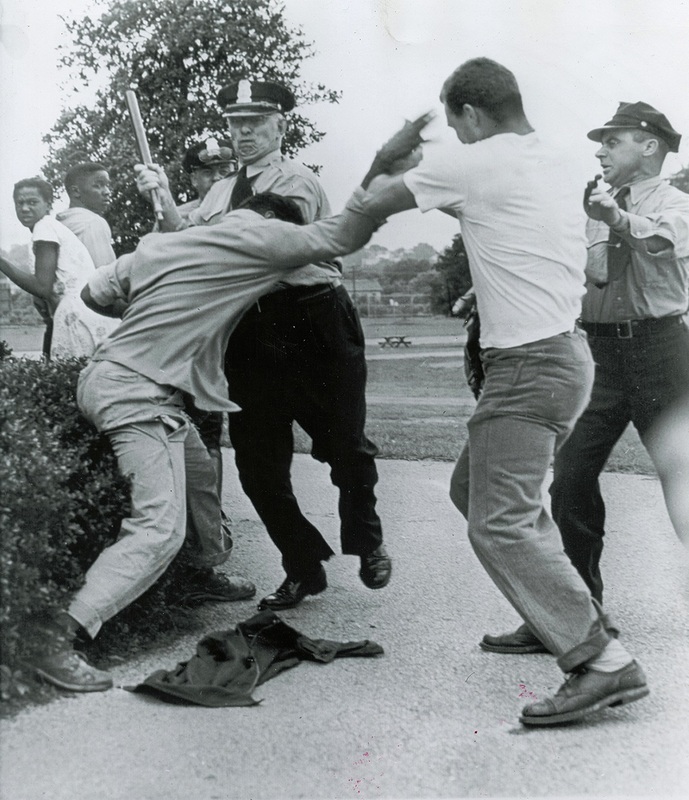
    <title type="html"><![CDATA[Civil Rights Tour: Recreation - Anacostia Pool, Swimming for All: 1800 Anacostia Drive SE]]></title>
    <summary type="html"><![CDATA[<p><strong><em><div style="text-align:center;">As summer began in 1949, African American residents of far Northeast and Southeast looked forward to finally having access to a swimming pool on their side of the Anacostia River.</div></em></strong></p><img src="https://historicsites.dcpreservation.org/files/fullsize/00023406390194a0318b55e086c223c1.jpg" alt="In June 1949, after the federal government announced the desegregation of Anacostia Pool, racial violence broke out when black children entered the facility." /><br/><p>National Capital Parks (NCP), the federal entity that operated six of the city’s eight public pools, announced it would desegregate Anacostia Pool on June 23. But when African American children showed up to swim that day, they were met with threats by a group of white boys who surrounded them and drove them away.  </p><p>Similar confrontations over the next few days led to violence.  On June 29, police broke up a crowd at the pool site, making arrests for disorderly conduct and the distribution of anti-segregation flyers. The US Department of the Interior, which oversaw National Capital Parks, closed Anacostia Pool for the rest of the summer. </p><p>Historically, the District’s federal recreation facilities such as golf courses, certain parks, swimming pools, and tennis courts were officially open to everyone, but, by custom, whites claimed four of the federal pools (Anacostia, East Potomac Park, McKinley, Takoma), and relegated just two (Banneker and Francis) to African Americans.  Meanwhile, the DC Recreation Board refused to integrate any of its facilities, including most of the city’s playgrounds and its two whites-only pools (Georgetown and Rosedale). As a result, NCP retained control of its pools rather than transfer them to the DC Board of Recreation as planned.  Anacostia Pool re-opened on a non-segregated basis in 1950.</p><p>Because they were barred from public pools, many African American children never learned to swim. Between 1945 and 1948, 29 of 37 school-aged boys who drowned in the city were black.  At <a href="https://historicsites.dcpreservation.org/items/show/966">Rosedale Playground</a> in Kingman Park, the 1952 drowning of a teenager who had climbed the fence to swim sparked pickets and direct action by residents, leading the DC Department of Recreation to de-segregate Rosedale Pool that fall.</p><p><em><strong><a href="https://historicsites.dcpreservation.org/items/show/914">For more (including 2 images) view the original article</a></strong></em></p>]]></summary>
    <published>2018-12-20T01:30:58+00:00</published>
    <updated>2026-03-25T12:52:48+00:00</updated>
    <link rel="alternate" type="text/html" href="https://historicsites.dcpreservation.org/items/show/914"/>
    <id>https://historicsites.dcpreservation.org/items/show/914</id>
    <author>
      <name>DC Historic Preservation Office</name>
    </author>
  </entry>
</feed>