<?xml version="1.0" encoding="UTF-8"?>
<feed xmlns="http://www.w3.org/2005/Atom">
  <title type="text">DC Historic Sites</title>
  <updated>2026-03-25T12:52:50+00:00</updated>
  <generator uri="http://framework.zend.com" version="1.12.20">Zend_Feed_Writer</generator>
  <link rel="alternate" type="text/html" href="https://historicsites.dcpreservation.org/"/>
  <link rel="self" type="application/atom+xml" href="https://historicsites.dcpreservation.org/items/browse?output=rss2"/>
  <id>https://historicsites.dcpreservation.org/</id>
  <author>
    <name>DC Historic Sites</name>
    <uri>https://historicsites.dcpreservation.org</uri>
  </author>
  <link rel="hub" href="https://pubsubhubbub.appspot.com/"/>
  <entry>
    <title type="html"><![CDATA[Civil Rights Tour: Legal Campaigns - Supreme Court, Arbiter of Civil Rights: 1 First Street NE]]></title>
    <summary type="html"><![CDATA[<img src="https://historicsites.dcpreservation.org/files/fullsize/602f899d2a3f0ca6bc27f8c453c431c3.jpg" alt="US Supreme Court, 1950" /><br/><p>As the highest court of the land, the United States Supreme Court is ultimately where significant, nationwide civil rights advances are made, and sometimes unmade. While Congress has a huge role, too, in advancing (or taking away) civil rights, it is up to the Court to determine how laws are interpreted and enforced.
In 1946, NAACP attorneys William Hastie and Thurgood Marshall came here to argue one of the first 20<sup>th</sup>-century civil rights cases to make it to the Supreme Court.  The case involved 27-year-old Irene Morgan, a mother of two who, while recovering from a miscarriage, was arrested in the summer of 1944 for refusing to give up her seat on a bus from Virginia to Baltimore, Maryland. Spottswood Robinson III, of the NAACP and <a href="https://historicsites.dcpreservation.org/items/show/940">Howard University Law School</a>, represented Morgan in the Virginia courts, arguing that the incompatibility of state laws regulating where people could sit served to impede interstate commerce. Although Robinson was unsuccessful, the Supreme Court ruled in <em>Morgan v. Virginia </em>that segregating interstate buses indeed posed an unconstitutional "burden on commerce."
Two years later, the Supreme Court found in <em>Shelley v. Kraemer </em>and the DC case <em>Hurd v. Hodge</em> that the enforcement of racially restrictive housing covenants violated the 14<sup>th</sup> Amendment and the Civil Rights Act of 1866. While African Americans continued to face significant barriers to housing, the real estate industry, banks, and white homeowner associations could no longer rely on the courts to maintain segregation through deed restrictions.
The Supreme Court's 1954 rulings in <em>Brown v. Board of Education of Topeka, Kansas </em>and the DC companion case <em>Bolling v. Sharpe </em>struck down segregated schools as unconstitutional, reversing the court's landmark 1896 ruling in <em>Plessy v. Ferguson </em>that had established “separate but equal” as the law of the land. The court cited <em>Brown v. Board </em>in 1956, when it ruled in the Montgomery, Alabama case <em>Browder v. Gayle</em> that the Constitution prohibited separating intrastate bus passengers by race.  
In 1960, the Supreme Court ruled in <em>Gomillion v. Lightfoot </em>that gerrymandering—in this case, altering the boundaries of Tuskegee, Alabama's electoral district so that it excluded African Americans altogether—violated the 15<sup>th</sup> Amendment.</p><p>The Supreme Court began to effectively dismantle schemes aimed at furthering integration beginning in 1974, when it ruled in <em>Millikan v. Bradley </em>that a suburban school district could not be required to join the city of Detroit in implementing a busing program designed to counter the influence of residential segregation on the area's public schools. The court's 1978 decision in <em>University of California v. Bakke</em> held that racial quotas violated the 14<sup>th</sup> Amendment, resulting in the erosion of universities' efforts to offer opportunities to minority students. Most recently, in <em>Shelby County, Alabama v. Holder </em>(2013)<em>, </em>the court eliminated a key requirement of the 1965 Voting Rights Act: that states with a history of preventing African Americans from voting must receive clearance from the federal <a href="https://historicsites.dcpreservation.org/items/show/1001">Department of Justice</a> to change any rules related to elections. Tools such as voter ID laws have since been adopted to suppress the black vote.  
The Greek Revival Supreme Court building dates to 1935.

<a href="#_ftnref1"></a></p><p><em><strong><a href="https://historicsites.dcpreservation.org/items/show/1026">For more view the original article</a></strong></em></p>]]></summary>
    <published>2019-09-19T05:39:49+00:00</published>
    <updated>2026-03-25T12:52:50+00:00</updated>
    <link rel="alternate" type="text/html" href="https://historicsites.dcpreservation.org/items/show/1026"/>
    <id>https://historicsites.dcpreservation.org/items/show/1026</id>
    <author>
      <name>DC Historic Preservation Office</name>
    </author>
  </entry>
  <entry>
    <title type="html"><![CDATA[Civil Rights Tour: Civic Activism - Ethel Payne, Washington Correspondent: 6101 16th Street NW]]></title>
    <summary type="html"><![CDATA[<p><strong><em><div style="text-align:center;">"I stick to my firm, unshakeable belief that the black press is an advocacy press, and that I, as a part of that press, can't afford the luxury of being unbiased."</div></em></strong></p><img src="https://historicsites.dcpreservation.org/files/fullsize/205db328a8df2ea1bda6a914d54ad1f0.jpg" alt="Ethel Payne, at center, photographed with other female  members of the Capital Press Club early in her career. " /><br/><p>As the Washington correspondent for <em>Chicago Defender</em> for 25 years, Ethel Lois Payne (1911-1991), quoted here, used journalism to raise awareness of racial discrimination and to demand justice. At her first White House press conference in February 1954, Payne questioned President Dwight D. Eisenhower about why the Howard University choir had been barred from a dinner at the Washington Coliseum by the police. The president, who was in attendance at the dinner event, chalked up the incident to a misunderstanding by the choir director. This was the first of many events and issues that the city’s white papers reported on only because Payne was in the press room. </p><p>Five months after her first White House press conference, Ethel Lois Payne asked the president if he'd support banning racial discrimination in interstate travel, drawing an angry rebuke and eliminating her chances of being called on again. "The white press was so busy asking questions on other issues that the Blacks and their problems were completely ignored," she said later. Indeed, she was the only reporter to ask how the White House would address racial discrimination in housing. Throughout her career, Payne continued to focus her attention on civil rights issues. She reported from the Columbia Heights home of Spottswood Bolling on the day of the Supreme Court's momentous decision in <em>Bolling v. Sharpe</em> and <em>Brown v. Board of Education</em>, and later covered the emerging leadership of the Reverend Dr. Martin Luther King, Jr., the desegregation of the University of Alabama, and the murder of Emmett Till. </p><p>In 1976, Payne co-chaired a national conference for Black women in the media that featured luminaries such as former presidential candidate Shirley Chisolm (D-NY). Raised in Englewood on Chicago's South Side, Payne became active in civil rights as a young woman; at 29, she received an award from the NAACP for recruiting more than 20 new members. In 1941, she joined Asa Philip Randolph's March on Washington Movement to demand compliance with a new law banning employment discrimination by federal contractors. After Randolph called off his march in exchange for an executive order establishing the Fair Employment Practices Commission, Payne was charged with making Black Chicagoans aware of the new rules and how to gain access to jobs. </p><p>In 1947, Payne was assaulted by a Chicago police officer when she defended a group of young men being arrested for loitering; shortly thereafter, in 1948, she left the city for good.</p><p>During her Washington years, Payne resided in various neighborhoods. Her last home—an apartment at The Rittenhouse on 16th Street where she lived from 1978 until her death in 1991—was described by the <em>Washington Post</em> as overflowing "with books, plants, posters from China and ivory plaques and figures from Africa" collected during her reporting years. Her neighbors in the building included Rev. Jesse Jackson and his wife, Jacqueline.</p><p><em><strong><a href="https://historicsites.dcpreservation.org/items/show/1020">For more (including 5 images) view the original article</a></strong></em></p>]]></summary>
    <published>2019-09-18T23:46:33+00:00</published>
    <updated>2026-03-25T12:52:50+00:00</updated>
    <link rel="alternate" type="text/html" href="https://historicsites.dcpreservation.org/items/show/1020"/>
    <id>https://historicsites.dcpreservation.org/items/show/1020</id>
    <author>
      <name>DC Historic Preservation Office</name>
    </author>
  </entry>
  <entry>
    <title type="html"><![CDATA[Civil Rights Tour: Legal Campaigns - James Nabrit, Legislating for Change: 654 Girard Street NW]]></title>
    <summary type="html"><![CDATA[<img src="https://historicsites.dcpreservation.org/files/fullsize/9bf7cacd1df30904a885eba727f9d581.jpg" alt="James Nabrit (right) descends the steps of the US Supreme Court following the team&#039;s victory in &lt;em&gt;Brown v. Board of Education&lt;/em&gt; and &lt;em&gt;Bolling v. Sharpe&lt;/em&gt;, May 1954." /><br/><p>In 1954, James Nabrit and co-lead attorney <a href="https://historicsites.dcpreservation.org/items/show/937">George E.C. Hayes</a> celebrated the outcome of <em>Bolling v. Sharpe</em>, DC's companion case to <em>Brown v. Board of Education</em>. For years, attorneys had argued in favor of equalizing white and Black schools, but in <em>Bolling</em> and <em>Brown</em>, they successfully attacked segregation as inherently unequal. Because DC is not a state, and therefore not necessarily subject to the 14th Amendment, Nabrit and Hayes under <em>Bolling</em> led the Court to establish that the federal government had the same obligation as would a state government in guaranteeing its citizens equal protection. </p><p>Several years earlier, in <em>Lane v. Wilson</em> (1939), Nabrit successfully argued before the Supreme Court that a law preventing African Americans from ever being able to vote in the Oklahoma was unconstitutional. Nabrit also prevailed in 1955, when the Supreme Court ruled in <em>Terry v. Adams</em> that pre-primary elections limited to white voters violated the 15th Amendment. (NAACP attorney <a href="https://historicsites.dcpreservation.org/items/show/1011">Thurgood Marshall</a> had won a similar case, <em>Smith v. Allright</em>, a decade earlier, but a private, whites-only association had continued to exercise control over which candidates advanced to the Democratic primaries in Texas.) </p><p>Throughout his active career as a trial attorney, Nabrit served on the faculty at Howard University Law School; he is credited with teaching the first formal course in civil rights law beginning in 1938. The documentation he gathered for this course, on some two thousand civil rights-related cases from across the country, provided support for continued litigation by Nabrit and his colleagues throughout the 1930s-50s. Nabrit became Howard University's president in 1960. In a decade of increasing campus unrest, students sharply criticized his conservative leadership and staged a 5-day takeover of the Administration Building in 1968. He retired the following year.</p><p>During the 1940s, Nabrit lived at the Howard Manor at 654 Girard Street NW.</p><p><em><strong><a href="https://historicsites.dcpreservation.org/items/show/1016">For more (including 3 images) view the original article</a></strong></em></p>]]></summary>
    <published>2019-09-18T22:53:13+00:00</published>
    <updated>2026-03-25T12:52:50+00:00</updated>
    <link rel="alternate" type="text/html" href="https://historicsites.dcpreservation.org/items/show/1016"/>
    <id>https://historicsites.dcpreservation.org/items/show/1016</id>
    <author>
      <name>DC Historic Preservation Office</name>
    </author>
  </entry>
  <entry>
    <title type="html"><![CDATA[Civil Rights Tour: Education - Morgan Community School : 2200 Champlain Street NW (Site)]]></title>
    <summary type="html"><![CDATA[<img src="https://historicsites.dcpreservation.org/files/fullsize/cabc707bae0d84448fde42435ac85ce1.jpg" alt="Morgan Elementary School, 1949" /><br/><p>Morgan School, which stood at 18th and California streets until 1977 (now occupied by the soccer field at Marie Reed Recreation Center), stood as a symbol of the success that this mostly Black community achieved in its fight to manage its own affairs and to run a public school that met the community's specific needs. </p><p>Originally built for white children, Morgan School was transferred to use by African Americans in 1929 when the new whites-only Adams Elementary opened one block west on 19th Street. When the Supreme Court ruled in <em>Bolling v. Sharpe</em> (1954) that segregated schools were unconstitutional, white and Black community members came together to form the Adams-Morgan Better Neighborhood Conference; the group's name soon became associated with the whole area. </p><p>Members worked to ensure high-quality, integrated schools in the neighborhood, and a decade later they persuaded the city to cede control of the two schools to a community school board led by Bishop Marie H. Reed. Before her death in 1969, Reed led residents in planning for a new community center to replace the aging and overcrowded Morgan School. The larger Marie Reed Elementary School and Recreation Center, renovated in 2016, continues to reflect the community’s vision. </p><p>Organizing around the school led residents to come together on other issues that threatened the neighborhood. The community helped stop the construction of a freeway along Florida Avenue and successfully resisted urban renewal plans for Adams Morgan, which would have displaced thousands of low-income, mostly African American residents. </p><p>Co-led by statehood activist <a href="https://historicsites.dcpreservation.org/items/show/929">Josephine Butler</a> and former <a href="https://historicsites.dcpreservation.org/items/show/968">Student Nonviolent Coordinating Committee</a> (SNCC) organizer Frank Smith, residents formed the Adams Morgan Organization (AMO) in 1972. When a real estate company bought several run-down rowhouses on Seaton Street with plans to evict the residents—mostly African American women and children with nowhere else to go—AMO successfully worked with the families to resist eviction and ultimately enabled some of them to purchase their houses. AMO brokered a deal with Perpetual Building Association requiring that as a condition of opening a branch at 18th Street and Columbia Road in the heart of Adams Morgan, the bank provide financing for Seaton Street residents. Perpetual complied and also agreed to making favorable loans to neighborhood residents.</p><p><em><strong><a href="https://historicsites.dcpreservation.org/items/show/1014">For more (including 3 images) view the original article</a></strong></em></p>]]></summary>
    <published>2019-09-18T22:00:07+00:00</published>
    <updated>2026-03-25T12:52:50+00:00</updated>
    <link rel="alternate" type="text/html" href="https://historicsites.dcpreservation.org/items/show/1014"/>
    <id>https://historicsites.dcpreservation.org/items/show/1014</id>
    <author>
      <name>DC Historic Preservation Office</name>
    </author>
  </entry>
  <entry>
    <title type="html"><![CDATA[Civil Rights Tour: Education - MLK Library, A Living Memorial: 901 G Street NW]]></title>
    <summary type="html"><![CDATA[<p><strong><em><div style="text-align:center;">". . . public libraries can no longer afford to have a policy of business as usual . . . . knowledge has always been recognized as a form of social power." </p><p>(Hardy Franklin, D.C. Central Public Library Director, July 1976)</div></em></strong></p><img src="https://historicsites.dcpreservation.org/files/fullsize/b13a98b1af61d6b1effdd42d0810ec4e.jpg" alt="Poster of MLK Library" /><br/><p>Upon its dedication in August 1972, the DC Public Library’s new central branch—designed by famed modernist architect Ludwig Mies Van der Rohe—became one of the first public buildings in the country to be named in honor of the Reverend Dr. Martin Luther King, Jr. (1929-1968). The naming of this iconic downtown edifice culminated four years of activism by residents from across the city. </p><p>African Americans comprised around 70 percent of DC's population, and many had known King both as a national figure and as a key ally in local campaigns for civil rights. </p><p>As King was first rising to national prominence as a co-leader of the Montgomery Bus Boycott in 1956, when he was just 27 years old, he visited DC and reportedly addressed 4,000 people at <a href="https://historicsites.dcpreservation.org/items/show/973">Vermont Avenue Baptist Church</a> and at Howard University's Rankin Chapel. He urged students to devote themselves to dismantling segregation and wealth inequality, emphasizing his concern with "the slums in this city." </p><p>In May 1957, King helped organize the Prayer Pilgrimage for Freedom, for which thousands of people converged at the Lincoln Memorial. There, on the third anniversary of the Supreme Court's decision in <em>Brown v. Board of Education</em> and <em>Bolling v. Sharpe</em>, he engaged the crowd in a call and response of "Give us the ballot!" Along with co-organizers, <a href="https://historicsites.dcpreservation.org/items/show/942">A. Philip Randolph</a> and the NAACP's Roy Wilkins, King was awarded a key to the city during this visit. King returned in April 1959, where he spoke at the Washington Monument grounds to some 26,000 marchers who had gathered to demand "the orderly and speedy integration of schools," according to a petition that was circulated there. (At the first Youth March for Integrated Schools, a year earlier, Coretta Scott King had delivered a speech on her husband's behalf.) </p><p>As DC's Black leadership ramped up its campaign for home rule in 1965—the District had lost the right to self-governance almost a century earlier—King joined the DC Coalition of Conscience and 5,000 home rule activists for a vigil at Lafayette Park in August 1965. King charged "Southern congressmen" with being "derelict in their duties and sacred responsibility to make justice and freedom a reality for all citizens of the District of Columbia." The event was co-chaired by <a href="https://historicsites.dcpreservation.org/items/show/1003">Rev. Walter Fauntroy</a>, who invited King back to DC two years later to lead a parade through the Shaw neighborhood in support of a community-controlled urban renewal project. </p><p>In February 1968, King joined 2,500 members of Clergy and Laity Concerned about Vietnam in defying a court injunction to hold a service at Arlington National Cemetery in honor of fallen soldiers. During this visit, he also met with Black Panther H. Rap Brown and Stokely Carmichael, founder of D.C.'s Black United Front, in hopes of persuading them to support his Poor People's Campaign. A month later, and just five days before he was assassinated in Memphis, King delivered his last address in DC at the National Cathedral. Sit-ins at the District Building to demand that the city honor King with a holiday began in May 1968, prompting Council hearings and annual remembrances. The call for residents' input on a name for the new library prompted hundreds to weigh in, including school children. As a racially integrated facility devoted to learning, in a downtown area that had formerly been largely off-limits to black Washingtonians, the new central library was a fitting memorial to King. A Black Studies Division was launched during the first year it opened, and its free meeting rooms and event spaces have since become sites for political organizing and activism</p><p><em><strong><a href="https://historicsites.dcpreservation.org/items/show/1013">For more (including 5 images) view the original article</a></strong></em></p>]]></summary>
    <published>2019-09-18T19:50:55+00:00</published>
    <updated>2026-03-25T12:52:50+00:00</updated>
    <link rel="alternate" type="text/html" href="https://historicsites.dcpreservation.org/items/show/1013"/>
    <id>https://historicsites.dcpreservation.org/items/show/1013</id>
    <author>
      <name>DC Historic Preservation Office</name>
    </author>
  </entry>
  <entry>
    <title type="html"><![CDATA[Civil Rights Tour: Legal Campaigns - Thurgood Marshall, From Howard U to Highest Court: 64 G Street SW]]></title>
    <summary type="html"><![CDATA[<p><strong><em><div style="text-align:center;">"Liberty is not the loser when the pressures of conformity to prejudice are removed by law." (Thurgood Marshall, Solicitor General of the United States, March 1967)</div></em></strong></p><img src="https://historicsites.dcpreservation.org/files/fullsize/cbab3d48285cf2602ab91a5e562a1cfa.jpg" alt="NAACP Chief Counsel Thurgood Marshall with US Capitol behind him, appealed to the Supreme Court on behalf of the Little Rock Nine, August 1958." /><br/><p>In the same year that President Lyndon B. Johnson asked him to serve as the first African American Supreme Court Justice, US Solicitor General Thurgood Marshall used these words in defense of the federal government's opposition to a California state constitutional amendment affirming the right of landlords and real estate officials to discriminate. In <em>Reitman v. Mulkey, </em>the US Supreme Court agreed with Marshall's argument, ruling this a violation of the 14<sup>th</sup> Amendment.
Marshall had been a lead civil rights attorney since the 1930s, after graduating from <a href="https://historicsites.dcpreservation.org/items/show/940">Howard University Law School </a>at the top of his class. As a student, he had joined <a href="https://historicsites.dcpreservation.org/items/show/939">Charles Hamilton Houston</a>, <a href="https://historicsites.dcpreservation.org/items/show/1016">James Nabrit</a>, and others in providing free legal assistance to DC's <a href="https://historicsites.dcpreservation.org/items/show/958">New Negro Alliance</a>. He then began working with Houston and the NAACP on dismantling the racial segregation of schools, beginning with a case against University of Maryland Law School, which admitted whites only. The Maryland Court of Appeals ruled in <em>Pearson v. Murray </em>(1936) that the university's racial ban violated the 14<sup>th</sup> Amendment. In 1950, Marshall argued before the US Supreme Court that "separate but equal" facilities for Black law school students were also unconstitutional. Such schools not only lacked sufficient facilities and enough faculty, but also prevented black students from participating in the free exchange of ideas and views that was fundamental to a legal education, Marshall argued.This case, <em>Sweatt v. Painter,</em> set precedent for the Supreme Court's 1954 decision in <em>Brown v. Board of Education. </em>
Marshall and his family moved to Southwest DC from New York in the fall of 1965 when Marshall was appointed Solicitor General. As a Supreme Court Justice from 1967 until his retirement in 1991, he consistently argued against capital punishment and defended the rights of people charged with crimes. In the landmark affirmative action case, <em>University of California v. Bakke </em>(1978), Marshall endorsed race-conscious admission standards. "[D]uring most of the last 200 years," he wrote, "the Constitution as interpreted by this court did not prohibit the most ingenious and persuasive forms of discrimination.... Now, when a state acts to remedy the effects of that legacy…, I cannot believe that this same Constitution stands as a barrier."</p><p><em><strong><a href="https://historicsites.dcpreservation.org/items/show/1011">For more (including 2 images) view the original article</a></strong></em></p>]]></summary>
    <published>2019-09-18T19:21:36+00:00</published>
    <updated>2026-03-25T12:52:50+00:00</updated>
    <link rel="alternate" type="text/html" href="https://historicsites.dcpreservation.org/items/show/1011"/>
    <id>https://historicsites.dcpreservation.org/items/show/1011</id>
    <author>
      <name>DC Historic Preservation Office</name>
    </author>
  </entry>
  <entry>
    <title type="html"><![CDATA[Civil Rights Tour: Protest - Howard University: 2400 6th Street NW]]></title>
    <summary type="html"><![CDATA[<p><strong><em><div style="text-align:center;">“We gonna lay down our shufflin’ shoes.”</div>
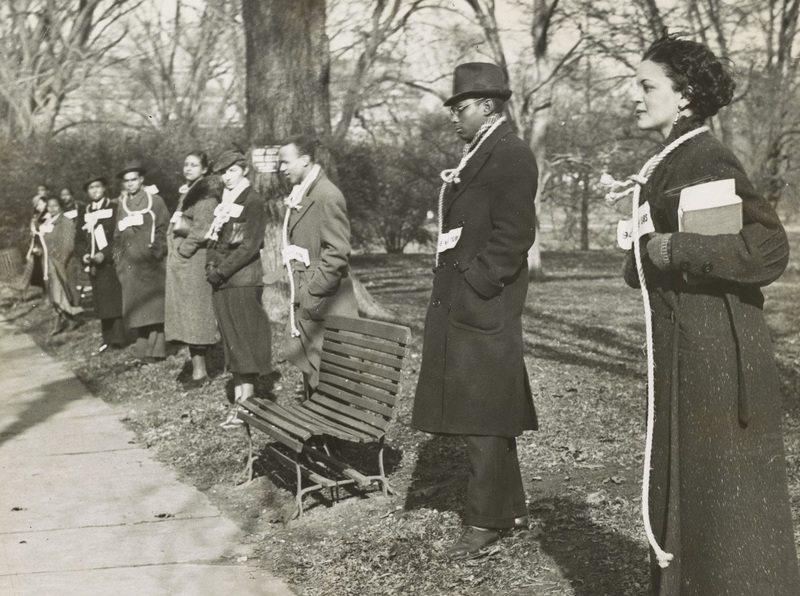
<div style="text-align:center;">(Howard University student protestors, 1968)</div></em></strong></p><img src="https://historicsites.dcpreservation.org/files/fullsize/1f1e46ed364429aa873d2f7929aaec2b.jpg" alt="Howard University students picket a National Crime Conference in DC, December 1934." /><br/><p>These first two lines of a song sung to the tune of “Down by the Riverside” by Howard University student protestors during a 1968 campus uprising capture the spirit of civic activism that has consistently defined a segment of the university’s student body. </p><p>Founded by an act of Congress in 1867 as the District's first institution of higher education to welcome African Americans, Howard students and professors have long engaged in political protests both on and off campus. Individually and collectively, their actions have contributed to the desegregation of public and private facilities in the city. In 1925, Howard's Glee Club and Choral Society walked out of a downtown theater upon discovering that the audience was segregated by race. Twelve years later, demands by the Howard community led to Marian Anderson's famous concert at the Lincoln Memorial. </p><p>In 1934, Howard students staged a protest outside a national conference on crime after learning that lynching—the most serious criminal justice issue facing the country—was not to be addressed. Professors and students also waged a six-month campaign that year to desegregate the restaurants within the US Capitol building, where African Americans had once been welcome. After Ralph Bunche and history professor Charles Wesley were turned away, and a Howard junior was fired from his job as a waiter for serving a fellow student, he and others rallied a group of students to demand entrance to one of the Capitol's whites-only cafes. Police assaulted and arrested the students, while Congressional Democrats tarred them as communists and as a "a mob of toughs and hoodlums." The dining rooms would remain segregated until the early 1950s. </p><p>In 1943, law students Pauli Murray and Ruth Powell organized students to protest the segregation of commercial establishments, clinching a short-lived victory at <a href="https://historicsites.dcpreservation.org/items/show/971">Thompson’s Restaurant</a> on Pennsylvania Avenue NW before Howard’s president Mordecai Johnson demanded an end to student sit-ins and picketing. In 1950, political science department chair Ralph Bunche and the Howard Teachers Union threatened to picket the National Theatre for barring African Americans, winning a temporary victory before the theater went back to its whites-only policy. </p><p>A 25-year old Howard divinity student named Laurence Henry led a group of Howard students, the Nonviolent Action Group (NAG), in picketing the US Capitol in March 1960 to demand passage of a federal civil rights bill. Henry went on to lead successful sit-ins at restaurants and lunch counters in northern Virginia, Rockville, and Bethesda, where he sustained a picket line for 100 hours straight. Henry also initiated the campaign to desegregate Glen Echo, an amusement park in Montgomery County, Maryland. After being beaten and arrested there by police in early August 1960, he was released from jail after waging a hunger strike. When Glen Echo's owners continued to bar black patrons, Henry led a 12-hour overnight march to Baltimore, where NAG demanded a federal court injunction against the park. It finally desegregated the following spring. </p><p>Henry went on to work with another Howard student, Stokely Carmichael, to demand federal government support for integrated schools, voting rights, non-discrimination by entities with federal contracts, and removing Congressional barriers to the passage of civil rights laws.</p><p><em><strong><a href="https://historicsites.dcpreservation.org/items/show/1009">For more (including 3 images) view the original article</a></strong></em></p>]]></summary>
    <published>2019-09-18T17:13:29+00:00</published>
    <updated>2026-03-25T12:52:50+00:00</updated>
    <link rel="alternate" type="text/html" href="https://historicsites.dcpreservation.org/items/show/1009"/>
    <id>https://historicsites.dcpreservation.org/items/show/1009</id>
    <author>
      <name>DC Historic Preservation Office</name>
    </author>
  </entry>
  <entry>
    <title type="html"><![CDATA[Civil Rights Tour: Civic Activism - Dorothy Ferebee, Access for All: 1809 2nd Street NW]]></title>
    <summary type="html"><![CDATA[<img src="https://historicsites.dcpreservation.org/files/fullsize/13bce81a36462e67f5379a6022e1e451.jpg" alt="Dorothy Ferebee (left) joined fellow members of the National Council of Negro Women in lobbying Congress at the US Capitol." /><br/><p>On her way to becoming a nationally renowned public health and civil rights activist in the 1940s, Dorothy Boulding Ferebee (1898-1980) moved to DC in 1925 for an internship at Howard University's Freedmen's Hospital. She had been among the top five graduates in her class at Tufts University. At Howard, Ferebee went on to serve as a longtime clinical instructor in obstetrics and to direct the university's health service. </p><p>Just four years after her arrival in DC, Ferebee established Southeast Settlement House at 301 G Street SE to provide recreation and daycare for children living around Capitol Hill, where the only other such facility served whites only. In 1935, she began spending her summers leading the Mississippi Health Project, a mobile clinic and education program for sharecropper families whose diets were commonly limited to items they could purchase at a worksite commissary. Many had never tasted fruit, Ferebee later recalled. The program was staffed by student members of the prestigious Alpha Kappa Alpha (AKA) sorority, of which Ferebee became national president in 1939. That spring, she also helped enroll more than 2,200 new members in the newly reorganized DC branch of the NAACP, as director of its fundraising campaign. </p><p>During World War II (1941-1945), Ferebee was a fierce advocate for increasing women's employment in the military and in government service, and in 1944, she played an integral role in desegregating the US Navy's women's branch, known as the WAVES. After the war, Ferebee succeeded Mary McLeod Bethune as president of the National Council of Negro Women, where she continued to fight for integration and equal pay in federal employment, voting rights, and access to health care. During her tenure at the helm of NCNW, Ferebee organized a reception at the Shoreham, marking the first time a major DC hotel had rented its main ballroom to African Americans. </p><p>In 1955, Ferebee joined a delegation of women in urging the US Attorney General to help quell racial violence in the South. "How can we tell the women in those areas to register and vote when they are in fear and terror of their lives if they attempt to exercise this right?" she asked. The group blamed the Attorney General for encouraging violence by neglecting to thoroughly investigate crimes against Black citizens or to put white supremacist citizens councils "on the subversive list." Ten years later, when she was 65, Ferebee traveled to Alabama to help register voters in a county where fewer than two percent of more than 15,000 eligible African Americans were registered to vote. </p><p>As chair of the DC Commission on the Status of Women in her later years, Ferebee advocated for the hiring of women police officers and against the expansion of prison facilities for women, who, she said, would be better served by community-based programs.</p><p>Dorothy Ferebee lived at 1809 2nd Street NW.</p><p><em><strong><a href="https://historicsites.dcpreservation.org/items/show/1005">For more (including 4 images) view the original article</a></strong></em></p>]]></summary>
    <published>2019-09-16T20:03:25+00:00</published>
    <updated>2026-03-25T12:52:50+00:00</updated>
    <link rel="alternate" type="text/html" href="https://historicsites.dcpreservation.org/items/show/1005"/>
    <id>https://historicsites.dcpreservation.org/items/show/1005</id>
    <author>
      <name>DC Historic Preservation Office</name>
    </author>
  </entry>
  <entry>
    <title type="html"><![CDATA[Civil Rights Tour: Legal Campaigns - Department of Justice, Enforcing Civil Rights: 950 Pennsylvania Avenue NW]]></title>
    <summary type="html"><![CDATA[<p><strong><em>The US Department of Justice (DOJ), headquartered in a building designed for it as part of the Federal Triangle project in the 1930s, has been an essential tool in advancing African American civil rights.</em></strong></p><img src="https://historicsites.dcpreservation.org/files/fullsize/0763b5622fcad63ac5914ecea705e1b1.jpg" alt="Attorney General Robert Kennedy speaks to civil rights marchers in front of the Justice Department, June 1963" /><br/><p>In 1948, the agency’s preparation of a 123-page amicus brief in <em>Shelley v. Kraemer</em> and <em>Hurd v. Hodge</em>—which challenged courts' enforcement of racially restrictive deed covenants that were used to create and maintain whites-only neighborhoods—marked the beginning of the agency's unofficial partnership with the <a href="https://historicsites.dcpreservation.org/items/show/1015">NAACP</a>. In <em>Henderson v. United States</em> (1949), the agency challenged the longstanding legality of providing "separate-but-equal" facilities for African Americans, leading DOJ to make the same argument in <em>Brown v. Board of Education</em> and the DC companion case <a href="https://historicsites.dcpreservation.org/items/show/969"><em>Bolling v. Sharpe</em></a>. In <em>Brown</em>, the Supreme Court finally overturned the 1896 ruling in <em>Plessy v. Ferguson</em> that had upheld the provision of separate transportation, schools, and other public accommodations for African Americans. Segregated schools violated the 5th and 14th amendments, said the Court. </p><p>Established in 1957, DOJ's Civil Rights Division was initially charged with defending black voting rights in the South, especially after the Supreme Court ruled in 1960 that gerrymandering—the adjustment of voting district boundaries to suppress the influence of black voters—violated the 15th Amendment. (Protecting black voting rights had been the reason for DOJ's establishment in 1870.) After the passage of the 1965 Voting Rights Act, the Division helped eliminate literacy tests and other barriers to black voting. It also worked to enforce court orders mandating the desegregation of universities (Division Director John Doar escorted James Meredith onto the University of Mississippi's campus in 1962); to desegregate interstate travel as required by the 1964 Civil Rights Act; and to investigate racially targeted violence, including the 1963 bombing of the 16th Street Baptist Church in Birmingham, Alabama, and the 1965 murders in Alabama of Viola Liuzzo and Rev. James Reeb. </p><p>In the 1990s, the Division's investigation of black church burnings resulted in hundreds of arrests. Following the brutal beating by Los Angeles police of Rodney King in 1991, DOJ was charged with investigating and overseeing police departments across the country, including in DC. </p><p>The FBI, which is part of DOJ, essentially endorsed racial violence in the South until the 1960s by neglecting to prevent or investigate lynchings, debt peonage, police terror, voter suppression, and other tools of maintaining white supremacy. The FBI also wiretapped the Rev. Dr. Martin Luther King, Jr. and his colleagues, and used undercover surveillance to track individuals and groups such as <a href="https://historicsites.dcpreservation.org/items/show/942">A. Philip Randolph</a>, <a href="https://historicsites.dcpreservation.org/items/show/938">Julius Hobson</a>, the NAACP, the <a href="https://historicsites.dcpreservation.org/items/show/1017">National Negro Congress</a>, and the <a href="https://historicsites.dcpreservation.org/items/show/968">Student Nonviolent Coordinating Committee</a> (SNCC).</p><p><em><strong><a href="https://historicsites.dcpreservation.org/items/show/1001">For more (including 2 images) view the original article</a></strong></em></p>]]></summary>
    <published>2019-09-13T23:53:50+00:00</published>
    <updated>2026-03-25T12:52:50+00:00</updated>
    <link rel="alternate" type="text/html" href="https://historicsites.dcpreservation.org/items/show/1001"/>
    <id>https://historicsites.dcpreservation.org/items/show/1001</id>
    <author>
      <name>DC Historic Preservation Office</name>
    </author>
  </entry>
  <entry>
    <title type="html"><![CDATA[Civil Rights Tour: Education - John P. Davis and Equal Education Now!: 3115 14th Street NE]]></title>
    <summary type="html"><![CDATA[<img src="https://historicsites.dcpreservation.org/files/fullsize/932f53f9770b530f9db442c313936218.jpg" alt="John Davis leads his son away from Noyes Elementary School after being refused admission, February 1944." /><br/><p>In February 1944 former <a href="https://historicsites.dcpreservation.org/items/show/1017">National Negro Congress</a> leader John P. Davis attempted to enroll his five-year-old son Michael at Noyes Elementary School in his Brookland neighborhood and was turned away. Although approximately 100 elementary school-aged Black children lived in the area, Noyes admitted Whites only. Davis’s goal in attempting to enroll his son was to challenge the "separate-but-equal" school system by filing a lawsuit exposing the inequality of facilities available to White and Black children. When his suit was initially dismissed, Davis compiled a more detailed case, showing there were no elementary schools for African Americans within walking distance; the closest one was at least 17 blocks from his house. This was in contrast to white neighborhoods that had schools within close walking distance. </p><p>As it would for another decade, the court upheld segregated schools as constitutional. However, in a small victory, the DC Commissioners approved the school board's request for an elementary school to be built across the street from Davis's house at 3105 14th Street NE. The <em>Afro-American</em> newspaper reported in January 1945 that, as a result of Davis's lawsuit, the four-grade school for African American children had opened with 75 children enrolled. The school was housed in a private residence with two portable buildings before the Lucy Diggs Slowe Elementary School opened on the site at 3115 14th Street NE in January 1948 to a larger 143-student body. (Slowe Elementary closed in 2009; its building is now occupied by the Mary McLeod Bethune Day Academy.) </p><p>A decade earlier, Davis had worked closely with fellow Dunbar High School graduate <a href="https://historicsites.dcpreservation.org/items/show/975">Robert C. Weaver</a>, who grew up several blocks north of Davis's home in Brookland. Together they pressured the Roosevelt administration to extend New Deal jobs and housing programs to African Americans, and to ensure Black workers received fair wages. Davis founded the National Negro Congress in 1936 and worked with its DC chapter to fight police brutality, organize and support labor unions, demand Black hiring by Capital Transit and other private employers, and persuade the federal government to desegregate recreation sites in the District.</p><p><em><strong><a href="https://historicsites.dcpreservation.org/items/show/1000">For more (including 4 images) view the original article</a></strong></em></p>]]></summary>
    <published>2019-09-13T23:12:45+00:00</published>
    <updated>2026-03-25T12:52:50+00:00</updated>
    <link rel="alternate" type="text/html" href="https://historicsites.dcpreservation.org/items/show/1000"/>
    <id>https://historicsites.dcpreservation.org/items/show/1000</id>
    <author>
      <name>DC Historic Preservation Office</name>
    </author>
  </entry>
</feed>