<?xml version="1.0" encoding="UTF-8"?>
<feed xmlns="http://www.w3.org/2005/Atom">
  <title type="text">DC Historic Sites</title>
  <updated>2026-03-25T12:52:50+00:00</updated>
  <generator uri="http://framework.zend.com" version="1.12.20">Zend_Feed_Writer</generator>
  <link rel="alternate" type="text/html" href="https://historicsites.dcpreservation.org/"/>
  <link rel="self" type="application/atom+xml" href="https://historicsites.dcpreservation.org/items/browse?output=rss2"/>
  <id>https://historicsites.dcpreservation.org/</id>
  <author>
    <name>DC Historic Sites</name>
    <uri>https://historicsites.dcpreservation.org</uri>
  </author>
  <link rel="hub" href="https://pubsubhubbub.appspot.com/"/>
  <entry>
    <title type="html"><![CDATA[Civil Rights Tour: Recreation - Uline Arena and E.B. Henderson: Third and M Streets NE]]></title>
    <summary type="html"><![CDATA[<img src="https://historicsites.dcpreservation.org/files/fullsize/c7b53e019a3b72e28b791d41b5fbf4c7.jpg" alt="Washington Coliseum" /><br/><p>Uline Arena became the largest venue in the city for sports events when it opened in 1941, but its whites-only policy in an increasingly Black city, and in a neighborhood where many African Americans lived, made it a source of controversy and a site of protest. Although the renowned activist and performer Paul Robeson gave a concert here in the venue's opening year, the arena remained mostly off-limits to black Washingtonians. 
Pickets and boycotts targeting Uline were led by Dr. Edwin B. Henderson, the longtime director of health and physical education for DC's Black schools and a leader of the <a href="https://historicsites.dcpreservation.org/items/show/1015">NAACP's D.C. Branch</a>. Henderson had learned to play basketball at Harvard, when the sport was first developing in the 1900s, and had founded the District's first Black basketball league at True Reformers Hall in 1908. He had formed school teams throughout the city and had organized DC's Black high school athletic conference as well as the first association of African American referees.   
Henderson's activism extended beyond the District's boundaries to Falls Church, Virginia, where he moved with his wife in 1913 and cofounded the NAACP's first rural branch. "Too many of our best young people move to Washington and their economic and cultural influence is lost to the community wherein they were brought up," Henderson later wrote of employment discrimination in Northern Virginia.</p><p>In some 3,000 letters to the editor that he penned during his lifetime, and as a columnist for the <em>Afro-American, </em>Henderson urged a boycott of the whites-only Washington Redskins in 1961 and praised the Police Boys Club's desegregation the following year.
Following Uline Arena's desegregation in 1948, Henderson helped organize an 80-person sit-in at the whites-only Child's Restaurant, across from Union Station. While unsuccessful, it paved the way for <a href="https://historicsites.dcpreservation.org/items/show/970">Mary Church Terrell</a>'s sit-ins and pickets at <a href="https://historicsites.dcpreservation.org/items/show/971">Thompson's Restaurant</a> beginning in 1950.</p><p>The Uline Arena became the Washington Coliseum in 1959, the same year that Nation of Islam leader Elijah Muhammed appeared with Malcolm X before an overflow crowd there. </p><p>The Uline Arena was listed in the National Register in 2007 and has since been renovated and coverted to office and retail space. </p><p><em><strong><a href="https://historicsites.dcpreservation.org/items/show/1027">For more (including 2 images) view the original article</a></strong></em></p>]]></summary>
    <published>2019-09-19T05:50:13+00:00</published>
    <updated>2026-03-25T12:52:50+00:00</updated>
    <link rel="alternate" type="text/html" href="https://historicsites.dcpreservation.org/items/show/1027"/>
    <id>https://historicsites.dcpreservation.org/items/show/1027</id>
    <author>
      <name>DC Historic Preservation Office</name>
    </author>
  </entry>
  <entry>
    <title type="html"><![CDATA[Civil Rights Tour: Employment - Marie Richardson, United Federal Workers&#039; Rep: 1638 Florida Avenue NW]]></title>
    <summary type="html"><![CDATA[<img src="https://historicsites.dcpreservation.org/files/fullsize/5c3f7b840edbfb12f5f09d19f0a2c577.jpg" alt="Protesters at 11th Street and Vermont Avenue NW, during a march against Capital Transit that Marie Richardson helped organize, May 1943." /><br/><p>Marie Richardson (1920-1987) became a labor and civil rights activist in the 1930s, while a student at <a href="https://historicsites.dcpreservation.org/items/show/924">Cardozo High School</a>. Her father handled baggage at Union Station, and together they helped organize the first local union in the country to represent station porters, or Red Caps. Once a national Red Caps union was established in 1938, Richardson founded and led its women's auxiliary while attending Howard University, studying law, and working at the Washington Navy Yard. There she became active in a federal employee union, rising to a position as the United Federal Workers' (UFW) national representative. For the UFW, she helped organize and demand higher wages and nondiscriminatory employment for federal workers, government cafeteria staff employed by private contractors, Freedmen's Hospital employees, and Howard University instructors.
In October 1941, Richardson was the lead organizer of the National Conference of Negro Youth, where, with fellow youth activists <a href="https://historicsites.dcpreservation.org/items/show/999">Thelma Dale</a> and <a href="https://historicsites.dcpreservation.org/items/show/1012">Jewell Mazique</a>, she helped launch a local committee to fight job discrimination in the District. The group focused its first campaign on Capital Transit, which operated all of DC's streetcars and buses and refused to hire African Americans for anything but low-level maintenance positions. They began by soliciting support from the <a href="https://historicsites.dcpreservation.org/items/show/1015">DC NAACP</a> and other organizations. In response to a petition signed by nearly 6,000 white and black Washingtonians who opposed the company's policy, the federal Fair Employment Practices Commission (FEPC) ordered Capital Transit to stop discriminating, but the company refused to require white operators to work with Black trainees. When civil rights attorney <a href="https://historicsites.dcpreservation.org/items/show/939">Charles Hamilton Houston</a> resigned from President Harry Truman's <a href="https://historicsites.dcpreservation.org/items/show/942">Committee on Fair Employment Practices</a> after the president ordered the FEPC not to comply with a committee directive to desegregate Capital Transit, Richardson drafted a letter to Truman for the <a href="https://historicsites.dcpreservation.org/items/show/1000">National Negro Congress's</a> (NNC) DC chapter. His order, she wrote, was "in substance, a declaration of support of the Jim Crow laws" and served as "a cynical welcome for colored veterans returning to their homes in Washington looking for fair employment."
Richardson also led the NNC's local campaign for the establishment of a permanent FEPC, to ensure Black access to jobs and decent wages after World War II ended. In early 1946, she led pickets at the homes of each US senator responsible for a blocking a bill to establish the permanent commission. Although the bill died, President Truman used an executive order to bar federal government discrimination. In her role as executive secretary of the NNC's local chapter, Richardson also campaigned for DC voting rights and against police brutality. In July 1947, she organized an anti-lynching rally that drew 500 people.
Richardson and her husband moved to New York in 1950. The following year, an FBI informant testified that she had been a member of the Communist Party, despite having signed a loyalty oath as a condition for temporary employment at the Library of Congress. No evidence supported the informant's claim, and Richardson's legal team included top civil rights attorneys <a href="https://historicsites.dcpreservation.org/items/show/937">George E.C. Hayes</a> and <a href="https://historicsites.dcpreservation.org/items/show/940">James A. Cobb</a>, but she was imprisoned for over four years.</p><p>Richardson lived at 1638 Florida Avenue NW.

<a href="#_ftnref1"></a></p><p><em><strong><a href="https://historicsites.dcpreservation.org/items/show/1024">For more (including 5 images) view the original article</a></strong></em></p>]]></summary>
    <published>2019-09-19T05:21:23+00:00</published>
    <updated>2026-03-25T12:52:50+00:00</updated>
    <link rel="alternate" type="text/html" href="https://historicsites.dcpreservation.org/items/show/1024"/>
    <id>https://historicsites.dcpreservation.org/items/show/1024</id>
    <author>
      <name>DC Historic Preservation Office</name>
    </author>
  </entry>
  <entry>
    <title type="html"><![CDATA[Civil Rights Tour: Protest - Poverty Rights Action Center, Welfare Rights: 1713 R Street NW]]></title>
    <summary type="html"><![CDATA[<p><strong><em><div style="text-align:center;">“There are more poor than rich people in this country, but Congress doesn’t seem to know it. If we organize, they’ll have to listen.” </p><p>(Catherine Jermany, welfare rights organizer)</div></em></strong></p><img src="https://historicsites.dcpreservation.org/files/fullsize/a92d9ed8530dded2d4176dde47deff14.jpg" alt="In May 1868, the National Welfare Rights Organization helped launch the Poor People&#039;s Campaign with a Mother&#039;s Day march through Shaw. " /><br/><p>Poverty/Rights Action Center (P/RAC) opened its offices at 1713 R Street in April 1966 as an organizing base for grassroots activists across the country—mostly poor, Black women determined to ensure that they had a voice in President Lyndon B. Johnson's War on Poverty. </p><p>Founder George T. Wiley, a former national leader of the Congress of Racial Equality (CORE), worked alongside his wife Wretha Wiley and welfare rights organizers in Ohio, New York, DC, and elsewhere, cofounding the National Welfare Rights Organization (NWRO) in August 1966. P/RAC served as the national headquarters for the NWRO, which coordinated direct-action campaigns and legal efforts challenging punitive and racist welfare policies. </p><p>Wiley and his colleagues, including NWRO chair Johnnie Tillmon of Los Angeles, engaged federal policymakers and national leaders such as the Reverend Dr. Martin Luther King, Jr. in recognizing welfare recipients as a potent political force in advancing African American civil rights. The group organized marches and sit-ins on Capitol Hill and coordinated local groups throughout the US to lobby Congress, with the fundamental mission of establishing the right to a guaranteed minimum income. </p><p>In September 1966, the NWRO brought to DC some 2,000 people, members of 31 delegations from throughout the US, to a Poor People's March on Washington, a precursor to the Southern Christian Leadership's convergence on the National Mall two years later. Several months after that, in February 1967, NWRO brought 375 activists to DC for three days of seminars on welfare rights and lobbying on the Hill. </p><p>The group staged its first national convention that August, at Trinity College. Etta Horn, a tenant leader at <a href="https://historicsites.dcpreservation.org/items/show/915">Barry Farm Dwellings</a>, was the NWRO's vice-chair and frequently testified before Congressional subcommittees to protest cuts to public assistance and the constant surveillance of welfare recipients. Families could be disqualified from receiving funds if a man—presumed to be capable of supporting the household—appeared to be living in the home. </p><p>The NWRO is credited with helping turn Dr. King's attention toward Black economic advancement, a goal of his 1968 Poor People's Campaign. In the last address he gave in DC, King vowed that the campaign would "establish that the real issue is not violence or nonviolence but poverty and neglect.</p><p><em><strong><a href="https://historicsites.dcpreservation.org/items/show/1023">For more (including 3 images) view the original article</a></strong></em></p>]]></summary>
    <published>2019-09-19T05:07:01+00:00</published>
    <updated>2026-03-25T12:52:50+00:00</updated>
    <link rel="alternate" type="text/html" href="https://historicsites.dcpreservation.org/items/show/1023"/>
    <id>https://historicsites.dcpreservation.org/items/show/1023</id>
    <author>
      <name>DC Historic Preservation Office</name>
    </author>
  </entry>
  <entry>
    <title type="html"><![CDATA[Civil Rights Tour: Protest - O Street Mansion, Rosa Parks&#039; &quot;Home Away from Home.&quot;: 2020 O Street NW]]></title>
    <summary type="html"><![CDATA[<img src="https://historicsites.dcpreservation.org/files/fullsize/2edf0cb37ed2d190350a7aa916efc55d.jpg" alt="Rosa Parks with DC politician and civil rights activist C. Delores Tucker." /><br/><p>The O Street Mansion was the Washington home-away-from-home of civil rights icon Rosa Parks (1913-2005) during her later years. Already a seasoned organizer, activist, and member of the NAACP, Parks helped spark the Civil Rights Movement in 1955 by refusing to give up her seat to a white man on a segregated Montgomery, Alabama bus. Three-quarters of the riders on city buses were African Americans, and some, fed up with racist abuse at the hand of drivers and white passengers, had been planning a boycott. Parks’s arrest became the triggering event, earning her the nickname “mother of the civil rights movement.” </p><p>Decades later, in 1994, Parks was left injured and traumatized after a targeted attack and robbery inside her Detroit home. At the request of their mutual friend Willis Edwards, president of the Beverly Hills branch of the NAACP, a Washington, DC hotelier, Ms. H.H. Leonards invited Parks to rest and heal at her Dupont Circle home and inn, known as the O Street Mansion. Parks eventually returned to Detroit but stayed with Lady H (Parks’ name for Leonards) during her frequent visits to DC. It was at the O Street Mansion that Parks met with heads of state and other dignitaries, as well as entertainers, and friends, and occasionally hosted formal Sunday Gospel Brunches, for example one in December 1998 to commemorate the 43rd anniversary of the start of the Montgomery bus boycott and another the next June to mark her receipt of the Congressional Gold Medal. </p><p>Over the years the O Street Mansion, which comprises five historic and more recent adjoining rowhouses (2016-2022 O Street) has hosted a number of other civil rights notables, including Willis Edwards and Emmet Till’s mother, Mamie Bradley, and it has supported African American artists.</p><p><em><strong><a href="https://historicsites.dcpreservation.org/items/show/1019">For more (including 3 images) view the original article</a></strong></em></p>]]></summary>
    <published>2019-09-18T23:37:04+00:00</published>
    <updated>2026-03-25T12:52:50+00:00</updated>
    <link rel="alternate" type="text/html" href="https://historicsites.dcpreservation.org/items/show/1019"/>
    <id>https://historicsites.dcpreservation.org/items/show/1019</id>
    <author>
      <name>DC Historic Preservation Office</name>
    </author>
  </entry>
  <entry>
    <title type="html"><![CDATA[Civil Rights Tour: Protest - National Negro Congress, Demanding Change Through Direct Action: 717 Florida Avenue NW]]></title>
    <summary type="html"><![CDATA[<p><strong><em><div style="text-align:center;">"The persistent and forceful campaign which the Washington Council [of the National Negro Congress] and allied organizations have waged against police brutality in Washington has been one of the most significant battles for civil rights and personal freedom and security ever conducted in the District of Columbia."  </p><p>(Charles Hamilton Houston)</div></em></strong></p><img src="https://historicsites.dcpreservation.org/files/fullsize/92ed9e488d9d49643f2d38f4edcbfb9e.jpg" alt="The National Negro Congress organized picketing of the federal Office of War Production to demand black hiring, 1941.." /><br/><p>During a campaign to exonerate the Scottsboro Boys—a group of imprisoned Black Alabama youth in danger of being lynched—the local chapter of the National Negro Congress (NNC) held its first mass meeting in DC at Metropolitan Baptist Church (then at 13th and R streets NW) in 1936. At this meeting, NNC founder <a href="https://historicsites.dcpreservation.org/items/show/1000">John P. Davis</a> called for the group to address police brutality, so-called "urban lynching," in the nation's capital. Later that year, a Civilian Conservation Corps worker at the National Arboretum became "the fortieth colored person shot to death by Metropolitan police since 1925," reported the <em>Afro-American</em>, which also noted that "every officer involved has been exonerated." The NNC quickly ramped up its DC campaign, joining the newspaper, the NAACP, the Washington Bar Association and others in a coalition to demand that Congress investigate the "unnecessary and unlawful use of force" by District police. The radio station WOL broadcasted weekly on the topic. </p><p>Calling itself the Joint Committee for Civil Rights in the District of Columbia (and later the Citizens Committee Against Police Brutality), the coalition held a mock trial against "killer cops" in May 1937 at John Wesley AME Zion Church, 14th and Corcoran streets NW. <a href="https://historicsites.dcpreservation.org/items/show/937">George E.C. Hayes</a> acted as a prosecuting attorney and Lucy Diggs Slowe, Howard University Dean of Women, served as a mock judge. The trial brought attention to a large public audience the District's abusive treatment of its Black citizens. </p><p>After a series of violent episodes in the winter of 1937-38—a Howard student was beaten and a young man fleeing a traffic accident was fatally shot—the NNC-led coalition held mass meetings in the summer of 1938 at <a href="https://historicsites.dcpreservation.org/items/show/949">Lincoln Temple Congregational Church</a> and at <a href="https://historicsites.dcpreservation.org/items/show/973">Vermont Avenue Baptist Church</a>, where <a href="https://historicsites.dcpreservation.org/items/show/939">Charles Hamilton Houston</a> called for voting rights as a prerequisite for ending police terror in the District. That July, for the first time, an officer was indicted but was ultimately acquitted for fatally shooting a mentally ill veteran. The NNC continued to help organize protests and demand accountability, eventually gaining establishment of a civilian review board. </p><p>In contrast to more conservative allies such as the NAACP, the NNC promoted direct action. Its pickets at a federal agency charged with ensuring that African Americans were hired for war-related jobs led the Glenn Martin aircraft factory, near Baltimore, to integrate its workforce, and ultimately to employ 5,000 Black workers. </p><p>The local NNC also worked to desegregate federally operated parks and sports facilities, including the Washington Tourist Camp, which was open to whites only until April 1940. A 1939 report documenting segregated and prohibitively expensive recreation sites was produced by the NNC's <a href="https://historicsites.dcpreservation.org/items/show/999">Thelma Dale</a>, who also co-led a campaign to end discriminatory hiring practices by Capital Transit, which operated DC's streetcars. </p><p>During the 1930s, the NNC Headquarters were located at 717 Florida Avenue NW, built in 1922 as a bank with offices on the second story designed by the Black architecture firm, Woodson, Vaughn and Ferguson. The building currently has a restaurant on the first story. </p><p><em><strong><a href="https://historicsites.dcpreservation.org/items/show/1017">For more (including 4 images) view the original article</a></strong></em></p>]]></summary>
    <published>2019-09-18T23:16:01+00:00</published>
    <updated>2026-03-25T12:52:50+00:00</updated>
    <link rel="alternate" type="text/html" href="https://historicsites.dcpreservation.org/items/show/1017"/>
    <id>https://historicsites.dcpreservation.org/items/show/1017</id>
    <author>
      <name>DC Historic Preservation Office</name>
    </author>
  </entry>
  <entry>
    <title type="html"><![CDATA[Civil Rights Tour: Legal Campaigns - NAACP, DC Branch: 1019 U Street NW]]></title>
    <summary type="html"><![CDATA[<img src="https://historicsites.dcpreservation.org/files/fullsize/7cb6382a43e43121cdb1d6dbf04bdd2e.jpg" alt="NAACP anti-lynching protest at National Crime Conference in DC, December 1934." /><br/><p>Established in 1912, the National Association for the Advancement of Colored People's (NAACP) DC branch was the largest and most influential of some 50 branches across the United States. The group devoted itself to protesting racial discrimination and violence against Black residents in the nation's capital. Unlike the national NAACP, whose early leadership was mostly white, African Americans led the DC branch from the beginning and constituted most of its membership.</p><p><a href="https://historicsites.dcpreservation.org/items/show/936">Archibald A. Grimke</a> led the DC Branch for more than a decade during its formative years, beginning in 1913 when he grew the group's membership from 143 to 700. Under his leadership, the NAACP organized a rally to protest President Woodrow Wilson's segregation of the federal government, attracting nearly 10,000 people. In 1922, the branch helped organize 5,000 marchers to parade silently past the Capitol and the White House to spur passage of an anti-lynching bill that was pending in the Senate. This bill and subsequent bills died due to powerful opposition from Southern Democrats who filibustered. It was not until 2018 that the Senate passed anti-lynching legislation.</p><p>In the late 1920s and early ‘30s, the branch was victorious in getting segregation orders overturned at workplaces and in public facilities, and in securing the dismissal of at least two police officers for brutality against Black men. </p><p>Culminating decades of protest against violent policing, in 1957 the branch presented the DC Commissioners with a scathing report, detailed affidavits, and photographic evidence testifying to the abusive treatment of Black Washingtonians, including women and children. "Our police department is the most dangerous spot in the District," remarked branch president Eugene Davidson. The department was also charged with the discriminatory hiring and treatment of officers, but after nine days of hearings, the Commissioners refused all of the branch's policy recommendations and fully exonerated the police.</p><p>During the 1920s and 1930s, the NAACP-DC had its headquarters at the small 19th century rowhouse with a storefront at 1019 U Street NW. The building currently houses a barbershop in its first floor shop. </p><p><a href="#_ftnref1"></a></p><p><em><strong><a href="https://historicsites.dcpreservation.org/items/show/1015">For more (including 5 images) view the original article</a></strong></em></p>]]></summary>
    <published>2019-09-18T22:40:25+00:00</published>
    <updated>2026-03-25T12:52:50+00:00</updated>
    <link rel="alternate" type="text/html" href="https://historicsites.dcpreservation.org/items/show/1015"/>
    <id>https://historicsites.dcpreservation.org/items/show/1015</id>
    <author>
      <name>DC Historic Preservation Office</name>
    </author>
  </entry>
  <entry>
    <title type="html"><![CDATA[Civil Rights Tour: Education - MLK Library, A Living Memorial: 901 G Street NW]]></title>
    <summary type="html"><![CDATA[<p><strong><em><div style="text-align:center;">". . . public libraries can no longer afford to have a policy of business as usual . . . . knowledge has always been recognized as a form of social power." </p><p>(Hardy Franklin, D.C. Central Public Library Director, July 1976)</div></em></strong></p><img src="https://historicsites.dcpreservation.org/files/fullsize/b13a98b1af61d6b1effdd42d0810ec4e.jpg" alt="Poster of MLK Library" /><br/><p>Upon its dedication in August 1972, the DC Public Library’s new central branch—designed by famed modernist architect Ludwig Mies Van der Rohe—became one of the first public buildings in the country to be named in honor of the Reverend Dr. Martin Luther King, Jr. (1929-1968). The naming of this iconic downtown edifice culminated four years of activism by residents from across the city. </p><p>African Americans comprised around 70 percent of DC's population, and many had known King both as a national figure and as a key ally in local campaigns for civil rights. </p><p>As King was first rising to national prominence as a co-leader of the Montgomery Bus Boycott in 1956, when he was just 27 years old, he visited DC and reportedly addressed 4,000 people at <a href="https://historicsites.dcpreservation.org/items/show/973">Vermont Avenue Baptist Church</a> and at Howard University's Rankin Chapel. He urged students to devote themselves to dismantling segregation and wealth inequality, emphasizing his concern with "the slums in this city." </p><p>In May 1957, King helped organize the Prayer Pilgrimage for Freedom, for which thousands of people converged at the Lincoln Memorial. There, on the third anniversary of the Supreme Court's decision in <em>Brown v. Board of Education</em> and <em>Bolling v. Sharpe</em>, he engaged the crowd in a call and response of "Give us the ballot!" Along with co-organizers, <a href="https://historicsites.dcpreservation.org/items/show/942">A. Philip Randolph</a> and the NAACP's Roy Wilkins, King was awarded a key to the city during this visit. King returned in April 1959, where he spoke at the Washington Monument grounds to some 26,000 marchers who had gathered to demand "the orderly and speedy integration of schools," according to a petition that was circulated there. (At the first Youth March for Integrated Schools, a year earlier, Coretta Scott King had delivered a speech on her husband's behalf.) </p><p>As DC's Black leadership ramped up its campaign for home rule in 1965—the District had lost the right to self-governance almost a century earlier—King joined the DC Coalition of Conscience and 5,000 home rule activists for a vigil at Lafayette Park in August 1965. King charged "Southern congressmen" with being "derelict in their duties and sacred responsibility to make justice and freedom a reality for all citizens of the District of Columbia." The event was co-chaired by <a href="https://historicsites.dcpreservation.org/items/show/1003">Rev. Walter Fauntroy</a>, who invited King back to DC two years later to lead a parade through the Shaw neighborhood in support of a community-controlled urban renewal project. </p><p>In February 1968, King joined 2,500 members of Clergy and Laity Concerned about Vietnam in defying a court injunction to hold a service at Arlington National Cemetery in honor of fallen soldiers. During this visit, he also met with Black Panther H. Rap Brown and Stokely Carmichael, founder of D.C.'s Black United Front, in hopes of persuading them to support his Poor People's Campaign. A month later, and just five days before he was assassinated in Memphis, King delivered his last address in DC at the National Cathedral. Sit-ins at the District Building to demand that the city honor King with a holiday began in May 1968, prompting Council hearings and annual remembrances. The call for residents' input on a name for the new library prompted hundreds to weigh in, including school children. As a racially integrated facility devoted to learning, in a downtown area that had formerly been largely off-limits to black Washingtonians, the new central library was a fitting memorial to King. A Black Studies Division was launched during the first year it opened, and its free meeting rooms and event spaces have since become sites for political organizing and activism</p><p><em><strong><a href="https://historicsites.dcpreservation.org/items/show/1013">For more (including 5 images) view the original article</a></strong></em></p>]]></summary>
    <published>2019-09-18T19:50:55+00:00</published>
    <updated>2026-03-25T12:52:50+00:00</updated>
    <link rel="alternate" type="text/html" href="https://historicsites.dcpreservation.org/items/show/1013"/>
    <id>https://historicsites.dcpreservation.org/items/show/1013</id>
    <author>
      <name>DC Historic Preservation Office</name>
    </author>
  </entry>
  <entry>
    <title type="html"><![CDATA[Civil Rights Tour: Employment - Jewell Mazique, Equal Employment Activist: 1861 California Street NW]]></title>
    <summary type="html"><![CDATA[<img src="https://historicsites.dcpreservation.org/files/fullsize/0e34bdd983645cf9521c84cba1e8a67d.jpg" alt="[Untitled]" /><br/><p>After receiving a master's in African Studies at Howard University, helping to raise three nieces in her Kalorama home, and working two jobs to put her husband through medical school, Jewell Mazique (1913-2007) quit her clerical position at the Library of Congress in the early 1940s to become a full-time labor and civil rights organizer. She went on to cover local and African affairs for the Afro-American newspaper, and to be a respected leader in the Black Power and pan-Africanist movements of the 1960s and '70s. </p><p>With <a href="https://historicsites.dcpreservation.org/items/show/999">Thelma Dale</a>, <a href="https://historicsites.dcpreservation.org/items/show/1024">Marie Richardson</a> and other local activists, Mazique helped launch a campaign in 1941 to desegregate Capital Transit, DC's privately owned bus and streetcar operator. Although seating wasn't segregated, as in other southern cities, the company hired African Americans only for poorly paid maintenance and custodial jobs. Mazique and her colleagues gathered support from the national NAACP, <a href="https://historicsites.dcpreservation.org/items/show/939">Charles Hamilton Houston</a>, <a href="https://historicsites.dcpreservation.org/items/show/922">Mary McLeod Bethune</a>, Howard University professor Doxey Wilkerson, and others for a mass meeting at <a href="https://historicsites.dcpreservation.org/items/show/973">Vermont Avenue Baptist Church</a> in November 1942, where Rev. Adam Clayton Powell was a featured speaker. </p><p>In 1943, after Capital Transit refused to comply with a desegregation order by the federal Fair Employment Practices Commission, Mazique helped launch pickets at the Commission's headquarters, in advance of scheduled hearings in May, and at busy intersections around the city. At least 800 people joined a march from 10th and U streets NW to Franklin Square, and more than 100 ministers of both white and African American congregations condemned the transit company's policy during Sunday sermons. However, without President Harry S. Truman's backing, and as the federal government began using Communism as a tool for punishing labor and civil rights leaders, it would take until 1955 to get Capital Transit to hire Black operators. </p><p>In addition to leading the campaign against Capital Transit, Mazique served as an officer of the National Council of the Southern Youth Congress, which pushed for full integration of the military and its training programs. In 1960, she represented the Washington Elks Civil Liberties League at a mass meeting on the FBI's cooperation with groups that were working to suppress black voting and economic participation. </p><p>Mazique and her husband Edward owned the three-story rowhouse at 1861 California Street NW from 1939 to 1945, before moving to 1824 Upshur Street NW, in DC's Crestwood neighborhood.</p><p><em><strong><a href="https://historicsites.dcpreservation.org/items/show/1012">For more (including 3 images) view the original article</a></strong></em></p>]]></summary>
    <published>2019-09-18T19:34:22+00:00</published>
    <updated>2026-03-25T12:52:50+00:00</updated>
    <link rel="alternate" type="text/html" href="https://historicsites.dcpreservation.org/items/show/1012"/>
    <id>https://historicsites.dcpreservation.org/items/show/1012</id>
    <author>
      <name>DC Historic Preservation Office</name>
    </author>
  </entry>
  <entry>
    <title type="html"><![CDATA[Civil Rights Tour: Civic Activism - IPS, Home for Radicals: 1520 New Hampshire Avenue NW]]></title>
    <summary type="html"><![CDATA[<img src="https://historicsites.dcpreservation.org/files/fullsize/8f23ee6e67ab117b0dd452544e31dc30.jpg" alt="1520 New Hampshire Avenue, office of the  Institute for Policy Studies from 1968 to 1978. " /><br/><p>Shortly after it was first established in 1963 as a left-leaning think tank directed by two former Kennedy administration staffers, Marcus Raskin and Richard Barnet, the Institute for Policy Studies (IPS) became a hub for civil rights activists, including lead organizers of the <a href="https://historicsites.dcpreservation.org/items/show/968">Student Nonviolent Coordinating Committee</a> (SNCC). IPS Fellow Robert Moses organized the 1964 Mississippi Freedom Summer, a massive voter registration drive conducted mostly by white college students recruited from the North in partnership with Black volunteers from the South. The summer project also generated membership in the Mississippi Freedom Democratic Party, which would soon send shock waves through the Democratic Party by demanding to be seated at the party's national convention in Atlantic City. </p><p>Frank Smith, a SNCC organizer who would eventually be elected to the DC Council, credits IPS with providing essential insider knowledge of Capitol Hill and strategic support for the Freedom Party, which brought national attention to Black disenfranchisement in the South. Smith first became affiliated with IPS during Freedom Summer. In 1966, the organization helped him bring 90 sharecroppers from Mississippi for a five-day camp-in across from the White House. Many had been kicked off rented land for registering to vote or for striking for better pay. They demanded that War on Poverty funds be provided to the groups helping them and other sharecroppers survive. </p><p>Over the next decade, IPS facilitated a network of intellectuals, activists, and policymakers focused on advancing black civil rights, working for women's liberation, and ending the Vietnam War. IPS also hosted political education seminars, giving local public housing tenants and welfare right advocates the opportunity to meet with grassroots activists from other parts of the country. Dick Gregory visited in 1967 during his campaign as a write-in candidate for US president. IPS "created synergy, intellectual engagement, and was productive," recalled Smith, who worked alongside fellow SNCC veteran Ivanhoe Donaldson to advise newly elected Black mayors throughout the country while at the same time building Black political power in DC, especially after the city regained home rule in 1974. </p><p>Other IPS fellows and staff included SNCC organizers Courtland Cox, Charles Sherrod, and John Wilson, who would later chair the DC Council; Tony Gittens, a co-founder of the <a href="https://historicsites.dcpreservation.org/items/show/931">Drum and Spear Bookstore</a>; Topper Carew, who created the New Thing Art and Architecture Center; and Roger Wilkins, who spent a decade at IPS beginning in 1982. Wilkins, the nephew of longtime NAACP director Roy Wilkins, helped organize the Free South Africa Movement during his tenure as a senior fellow at IPS. </p><p>From 1968 until 1978, IPS was located in a former townhouse at 1520 New Hampshire Avenue in Dupont Circle, now the Embassy of Jamaica. In 1978, the organization moved to R Street; it is currently located at 1301 Connecticut Avenue NW.</p><p><em><strong><a href="https://historicsites.dcpreservation.org/items/show/1010">For more (including 2 images) view the original article</a></strong></em></p>]]></summary>
    <published>2019-09-18T17:36:48+00:00</published>
    <updated>2026-03-25T12:52:50+00:00</updated>
    <link rel="alternate" type="text/html" href="https://historicsites.dcpreservation.org/items/show/1010"/>
    <id>https://historicsites.dcpreservation.org/items/show/1010</id>
    <author>
      <name>DC Historic Preservation Office</name>
    </author>
  </entry>
  <entry>
    <title type="html"><![CDATA[Civil Rights Tour: Protest - Howard University: 2400 6th Street NW]]></title>
    <summary type="html"><![CDATA[<p><strong><em><div style="text-align:center;">“We gonna lay down our shufflin’ shoes.”</div>
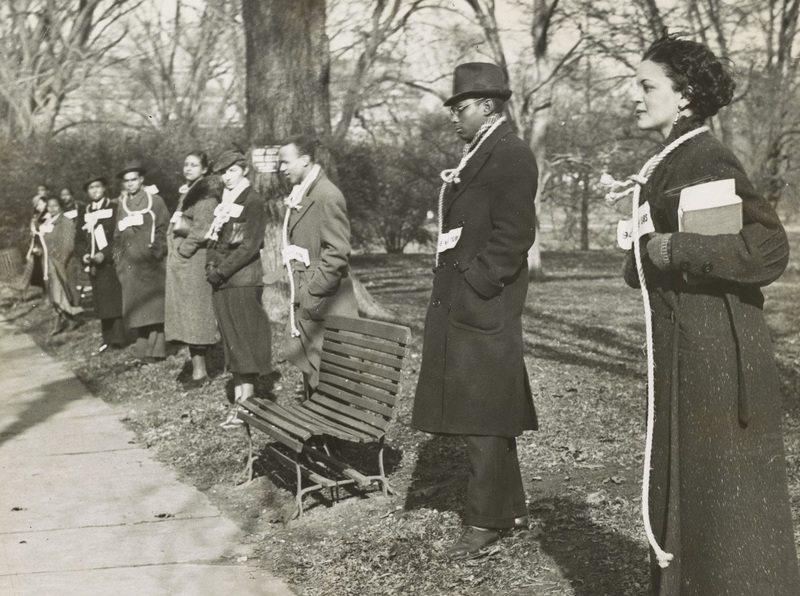
<div style="text-align:center;">(Howard University student protestors, 1968)</div></em></strong></p><img src="https://historicsites.dcpreservation.org/files/fullsize/1f1e46ed364429aa873d2f7929aaec2b.jpg" alt="Howard University students picket a National Crime Conference in DC, December 1934." /><br/><p>These first two lines of a song sung to the tune of “Down by the Riverside” by Howard University student protestors during a 1968 campus uprising capture the spirit of civic activism that has consistently defined a segment of the university’s student body. </p><p>Founded by an act of Congress in 1867 as the District's first institution of higher education to welcome African Americans, Howard students and professors have long engaged in political protests both on and off campus. Individually and collectively, their actions have contributed to the desegregation of public and private facilities in the city. In 1925, Howard's Glee Club and Choral Society walked out of a downtown theater upon discovering that the audience was segregated by race. Twelve years later, demands by the Howard community led to Marian Anderson's famous concert at the Lincoln Memorial. </p><p>In 1934, Howard students staged a protest outside a national conference on crime after learning that lynching—the most serious criminal justice issue facing the country—was not to be addressed. Professors and students also waged a six-month campaign that year to desegregate the restaurants within the US Capitol building, where African Americans had once been welcome. After Ralph Bunche and history professor Charles Wesley were turned away, and a Howard junior was fired from his job as a waiter for serving a fellow student, he and others rallied a group of students to demand entrance to one of the Capitol's whites-only cafes. Police assaulted and arrested the students, while Congressional Democrats tarred them as communists and as a "a mob of toughs and hoodlums." The dining rooms would remain segregated until the early 1950s. </p><p>In 1943, law students Pauli Murray and Ruth Powell organized students to protest the segregation of commercial establishments, clinching a short-lived victory at <a href="https://historicsites.dcpreservation.org/items/show/971">Thompson’s Restaurant</a> on Pennsylvania Avenue NW before Howard’s president Mordecai Johnson demanded an end to student sit-ins and picketing. In 1950, political science department chair Ralph Bunche and the Howard Teachers Union threatened to picket the National Theatre for barring African Americans, winning a temporary victory before the theater went back to its whites-only policy. </p><p>A 25-year old Howard divinity student named Laurence Henry led a group of Howard students, the Nonviolent Action Group (NAG), in picketing the US Capitol in March 1960 to demand passage of a federal civil rights bill. Henry went on to lead successful sit-ins at restaurants and lunch counters in northern Virginia, Rockville, and Bethesda, where he sustained a picket line for 100 hours straight. Henry also initiated the campaign to desegregate Glen Echo, an amusement park in Montgomery County, Maryland. After being beaten and arrested there by police in early August 1960, he was released from jail after waging a hunger strike. When Glen Echo's owners continued to bar black patrons, Henry led a 12-hour overnight march to Baltimore, where NAG demanded a federal court injunction against the park. It finally desegregated the following spring. </p><p>Henry went on to work with another Howard student, Stokely Carmichael, to demand federal government support for integrated schools, voting rights, non-discrimination by entities with federal contracts, and removing Congressional barriers to the passage of civil rights laws.</p><p><em><strong><a href="https://historicsites.dcpreservation.org/items/show/1009">For more (including 3 images) view the original article</a></strong></em></p>]]></summary>
    <published>2019-09-18T17:13:29+00:00</published>
    <updated>2026-03-25T12:52:50+00:00</updated>
    <link rel="alternate" type="text/html" href="https://historicsites.dcpreservation.org/items/show/1009"/>
    <id>https://historicsites.dcpreservation.org/items/show/1009</id>
    <author>
      <name>DC Historic Preservation Office</name>
    </author>
  </entry>
</feed>