<?xml version="1.0" encoding="UTF-8"?>
<feed xmlns="http://www.w3.org/2005/Atom">
  <title type="text">DC Historic Sites</title>
  <updated>2026-03-25T12:52:50+00:00</updated>
  <generator uri="http://framework.zend.com" version="1.12.20">Zend_Feed_Writer</generator>
  <link rel="alternate" type="text/html" href="https://historicsites.dcpreservation.org/"/>
  <link rel="self" type="application/atom+xml" href="https://historicsites.dcpreservation.org/items/browse?output=rss2"/>
  <id>https://historicsites.dcpreservation.org/</id>
  <author>
    <name>DC Historic Sites</name>
    <uri>https://historicsites.dcpreservation.org</uri>
  </author>
  <link rel="hub" href="https://pubsubhubbub.appspot.com/"/>
  <entry>
    <title type="html"><![CDATA[Civil Rights Tour: Recreation - Uline Arena and E.B. Henderson: Third and M Streets NE]]></title>
    <summary type="html"><![CDATA[<img src="https://historicsites.dcpreservation.org/files/fullsize/c7b53e019a3b72e28b791d41b5fbf4c7.jpg" alt="Washington Coliseum" /><br/><p>Uline Arena became the largest venue in the city for sports events when it opened in 1941, but its whites-only policy in an increasingly Black city, and in a neighborhood where many African Americans lived, made it a source of controversy and a site of protest. Although the renowned activist and performer Paul Robeson gave a concert here in the venue's opening year, the arena remained mostly off-limits to black Washingtonians. 
Pickets and boycotts targeting Uline were led by Dr. Edwin B. Henderson, the longtime director of health and physical education for DC's Black schools and a leader of the <a href="https://historicsites.dcpreservation.org/items/show/1015">NAACP's D.C. Branch</a>. Henderson had learned to play basketball at Harvard, when the sport was first developing in the 1900s, and had founded the District's first Black basketball league at True Reformers Hall in 1908. He had formed school teams throughout the city and had organized DC's Black high school athletic conference as well as the first association of African American referees.   
Henderson's activism extended beyond the District's boundaries to Falls Church, Virginia, where he moved with his wife in 1913 and cofounded the NAACP's first rural branch. "Too many of our best young people move to Washington and their economic and cultural influence is lost to the community wherein they were brought up," Henderson later wrote of employment discrimination in Northern Virginia.</p><p>In some 3,000 letters to the editor that he penned during his lifetime, and as a columnist for the <em>Afro-American, </em>Henderson urged a boycott of the whites-only Washington Redskins in 1961 and praised the Police Boys Club's desegregation the following year.
Following Uline Arena's desegregation in 1948, Henderson helped organize an 80-person sit-in at the whites-only Child's Restaurant, across from Union Station. While unsuccessful, it paved the way for <a href="https://historicsites.dcpreservation.org/items/show/970">Mary Church Terrell</a>'s sit-ins and pickets at <a href="https://historicsites.dcpreservation.org/items/show/971">Thompson's Restaurant</a> beginning in 1950.</p><p>The Uline Arena became the Washington Coliseum in 1959, the same year that Nation of Islam leader Elijah Muhammed appeared with Malcolm X before an overflow crowd there. </p><p>The Uline Arena was listed in the National Register in 2007 and has since been renovated and coverted to office and retail space. </p><p><em><strong><a href="https://historicsites.dcpreservation.org/items/show/1027">For more (including 2 images) view the original article</a></strong></em></p>]]></summary>
    <published>2019-09-19T05:50:13+00:00</published>
    <updated>2026-03-25T12:52:50+00:00</updated>
    <link rel="alternate" type="text/html" href="https://historicsites.dcpreservation.org/items/show/1027"/>
    <id>https://historicsites.dcpreservation.org/items/show/1027</id>
    <author>
      <name>DC Historic Preservation Office</name>
    </author>
  </entry>
  <entry>
    <title type="html"><![CDATA[Civil Rights Tour: Legal Campaigns - Supreme Court, Arbiter of Civil Rights: 1 First Street NE]]></title>
    <summary type="html"><![CDATA[<img src="https://historicsites.dcpreservation.org/files/fullsize/602f899d2a3f0ca6bc27f8c453c431c3.jpg" alt="US Supreme Court, 1950" /><br/><p>As the highest court of the land, the United States Supreme Court is ultimately where significant, nationwide civil rights advances are made, and sometimes unmade. While Congress has a huge role, too, in advancing (or taking away) civil rights, it is up to the Court to determine how laws are interpreted and enforced.
In 1946, NAACP attorneys William Hastie and Thurgood Marshall came here to argue one of the first 20<sup>th</sup>-century civil rights cases to make it to the Supreme Court.  The case involved 27-year-old Irene Morgan, a mother of two who, while recovering from a miscarriage, was arrested in the summer of 1944 for refusing to give up her seat on a bus from Virginia to Baltimore, Maryland. Spottswood Robinson III, of the NAACP and <a href="https://historicsites.dcpreservation.org/items/show/940">Howard University Law School</a>, represented Morgan in the Virginia courts, arguing that the incompatibility of state laws regulating where people could sit served to impede interstate commerce. Although Robinson was unsuccessful, the Supreme Court ruled in <em>Morgan v. Virginia </em>that segregating interstate buses indeed posed an unconstitutional "burden on commerce."
Two years later, the Supreme Court found in <em>Shelley v. Kraemer </em>and the DC case <em>Hurd v. Hodge</em> that the enforcement of racially restrictive housing covenants violated the 14<sup>th</sup> Amendment and the Civil Rights Act of 1866. While African Americans continued to face significant barriers to housing, the real estate industry, banks, and white homeowner associations could no longer rely on the courts to maintain segregation through deed restrictions.
The Supreme Court's 1954 rulings in <em>Brown v. Board of Education of Topeka, Kansas </em>and the DC companion case <em>Bolling v. Sharpe </em>struck down segregated schools as unconstitutional, reversing the court's landmark 1896 ruling in <em>Plessy v. Ferguson </em>that had established “separate but equal” as the law of the land. The court cited <em>Brown v. Board </em>in 1956, when it ruled in the Montgomery, Alabama case <em>Browder v. Gayle</em> that the Constitution prohibited separating intrastate bus passengers by race.  
In 1960, the Supreme Court ruled in <em>Gomillion v. Lightfoot </em>that gerrymandering—in this case, altering the boundaries of Tuskegee, Alabama's electoral district so that it excluded African Americans altogether—violated the 15<sup>th</sup> Amendment.</p><p>The Supreme Court began to effectively dismantle schemes aimed at furthering integration beginning in 1974, when it ruled in <em>Millikan v. Bradley </em>that a suburban school district could not be required to join the city of Detroit in implementing a busing program designed to counter the influence of residential segregation on the area's public schools. The court's 1978 decision in <em>University of California v. Bakke</em> held that racial quotas violated the 14<sup>th</sup> Amendment, resulting in the erosion of universities' efforts to offer opportunities to minority students. Most recently, in <em>Shelby County, Alabama v. Holder </em>(2013)<em>, </em>the court eliminated a key requirement of the 1965 Voting Rights Act: that states with a history of preventing African Americans from voting must receive clearance from the federal <a href="https://historicsites.dcpreservation.org/items/show/1001">Department of Justice</a> to change any rules related to elections. Tools such as voter ID laws have since been adopted to suppress the black vote.  
The Greek Revival Supreme Court building dates to 1935.

<a href="#_ftnref1"></a></p><p><em><strong><a href="https://historicsites.dcpreservation.org/items/show/1026">For more view the original article</a></strong></em></p>]]></summary>
    <published>2019-09-19T05:39:49+00:00</published>
    <updated>2026-03-25T12:52:50+00:00</updated>
    <link rel="alternate" type="text/html" href="https://historicsites.dcpreservation.org/items/show/1026"/>
    <id>https://historicsites.dcpreservation.org/items/show/1026</id>
    <author>
      <name>DC Historic Preservation Office</name>
    </author>
  </entry>
  <entry>
    <title type="html"><![CDATA[Civil Rights Tour: Protest - Howard University: 2400 6th Street NW]]></title>
    <summary type="html"><![CDATA[<p><strong><em><div style="text-align:center;">“We gonna lay down our shufflin’ shoes.”</div>
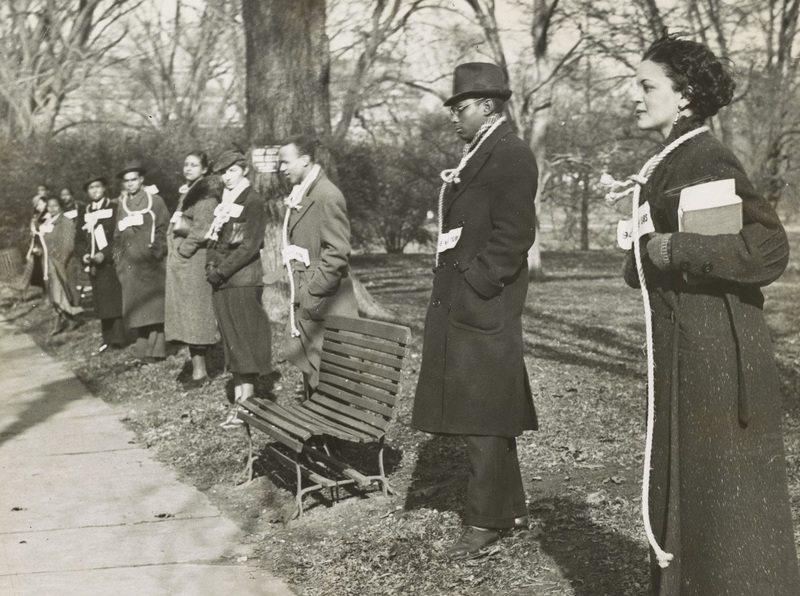
<div style="text-align:center;">(Howard University student protestors, 1968)</div></em></strong></p><img src="https://historicsites.dcpreservation.org/files/fullsize/1f1e46ed364429aa873d2f7929aaec2b.jpg" alt="Howard University students picket a National Crime Conference in DC, December 1934." /><br/><p>These first two lines of a song sung to the tune of “Down by the Riverside” by Howard University student protestors during a 1968 campus uprising capture the spirit of civic activism that has consistently defined a segment of the university’s student body. </p><p>Founded by an act of Congress in 1867 as the District's first institution of higher education to welcome African Americans, Howard students and professors have long engaged in political protests both on and off campus. Individually and collectively, their actions have contributed to the desegregation of public and private facilities in the city. In 1925, Howard's Glee Club and Choral Society walked out of a downtown theater upon discovering that the audience was segregated by race. Twelve years later, demands by the Howard community led to Marian Anderson's famous concert at the Lincoln Memorial. </p><p>In 1934, Howard students staged a protest outside a national conference on crime after learning that lynching—the most serious criminal justice issue facing the country—was not to be addressed. Professors and students also waged a six-month campaign that year to desegregate the restaurants within the US Capitol building, where African Americans had once been welcome. After Ralph Bunche and history professor Charles Wesley were turned away, and a Howard junior was fired from his job as a waiter for serving a fellow student, he and others rallied a group of students to demand entrance to one of the Capitol's whites-only cafes. Police assaulted and arrested the students, while Congressional Democrats tarred them as communists and as a "a mob of toughs and hoodlums." The dining rooms would remain segregated until the early 1950s. </p><p>In 1943, law students Pauli Murray and Ruth Powell organized students to protest the segregation of commercial establishments, clinching a short-lived victory at <a href="https://historicsites.dcpreservation.org/items/show/971">Thompson’s Restaurant</a> on Pennsylvania Avenue NW before Howard’s president Mordecai Johnson demanded an end to student sit-ins and picketing. In 1950, political science department chair Ralph Bunche and the Howard Teachers Union threatened to picket the National Theatre for barring African Americans, winning a temporary victory before the theater went back to its whites-only policy. </p><p>A 25-year old Howard divinity student named Laurence Henry led a group of Howard students, the Nonviolent Action Group (NAG), in picketing the US Capitol in March 1960 to demand passage of a federal civil rights bill. Henry went on to lead successful sit-ins at restaurants and lunch counters in northern Virginia, Rockville, and Bethesda, where he sustained a picket line for 100 hours straight. Henry also initiated the campaign to desegregate Glen Echo, an amusement park in Montgomery County, Maryland. After being beaten and arrested there by police in early August 1960, he was released from jail after waging a hunger strike. When Glen Echo's owners continued to bar black patrons, Henry led a 12-hour overnight march to Baltimore, where NAG demanded a federal court injunction against the park. It finally desegregated the following spring. </p><p>Henry went on to work with another Howard student, Stokely Carmichael, to demand federal government support for integrated schools, voting rights, non-discrimination by entities with federal contracts, and removing Congressional barriers to the passage of civil rights laws.</p><p><em><strong><a href="https://historicsites.dcpreservation.org/items/show/1009">For more (including 3 images) view the original article</a></strong></em></p>]]></summary>
    <published>2019-09-18T17:13:29+00:00</published>
    <updated>2026-03-25T12:52:50+00:00</updated>
    <link rel="alternate" type="text/html" href="https://historicsites.dcpreservation.org/items/show/1009"/>
    <id>https://historicsites.dcpreservation.org/items/show/1009</id>
    <author>
      <name>DC Historic Preservation Office</name>
    </author>
  </entry>
  <entry>
    <title type="html"><![CDATA[Civil Rights Tour: Employment - Elmer Henderson, Fighter for Equality: 1130 6th  Street NW]]></title>
    <summary type="html"><![CDATA[<img src="https://historicsites.dcpreservation.org/files/fullsize/e66c42512796cceb38c9921cce28b949.jpg" alt="Elmer Henderson descending US Capitol steps, June 1950" /><br/><p>Elmer W. Henderson was the plaintiff in a major civil rights case, a fair employment advocate for the federal government, and the longtime director of a national lobby for African American equality. </p><p>In May 1942, Henderson was denied seating on a Southern Railway dining car <em>en route</em> from DC to Atlanta, because the tables designated for Black passengers were partially occupied by white diners. Henderson recognized that he was unlikely to win a lawsuit against the railway, so instead filed a complaint with the Interstate Commerce Commission (ICC), which acknowledged he had been treated unfairly. However, when the railway proceeded to resolve the issue by designating two tables closest to the kitchen as the only seating for Black passengers, and required a curtain be drawn to hide their presence from white diners, Henderson sued again, and this time the US Department of Justice (DOJ) backed him up. </p><p>In a brief for this case, DOJ attorney Philip Elman attacked "separate-but-equal" seating, legalized half a century earlier by the U.S. Supreme Court’s 1896 <em>Plessy v. Ferguson</em> decision. The Court finally ruled, in 1950, that the railway had violated the Interstate Commerce Act, and, while it did not address the constitutionality of separating the races, DOJ's efforts in <em>Henderson v. United States</em> marked a turning point in the federal government's role in dismantling segregation. Influenced by his work on Henderson's case, attorney Elman became the principal author four years later of the Justice Department's brief in <em>Brown v. Board of Education</em>, which argued that separate-but-equal schools violated the Constitution. </p><p>During the 1940s, as his case moved through the courts, Elmer Henderson was the Midwest regional director for the Fair Employment Practices Commission, where he worked to ensure that African Americans were hired and paid fairly for World War II-related jobs. As the founding president of the American Council on Human Rights, beginning in 1948, Henderson lobbied Congress and President Harry S. Truman to end racial discrimination in the military and in non-government industries; African Americans were the first to be fired once the war was over. Henderson also urged the government to make direct loans to Black homebuilders as they were unable to secure bank loans, and to require white developers to integrate new housing. "The unwritten code of the home building and real estate industry in banning the sale of new houses to Negroes is still in full force," remarked Henderson in a 1954 speaking tour. </p><p>Here in DC, Henderson lobbied President Truman to appoint an African American to the DC Board of Commissioners, which governed the city for nearly a century before District citizens achieved home rule in 1974. "We have made this request many times before but…the time is peculiarly ripe for such an appointment," said Henderson in 1952, referring to the recent Census showing that black residents comprised more than a third of the city's population. Logan Circle resident and New Negro Alliance co-founder Belford V. Lawson represented Henderson in his cases against the U.S. government and Southern Railway as well as in a 1949 lawsuit that desegregated restaurants at the Cincinnati airport.</p><p>In the 1950s, Elmer Henderson's office was located at 1130 6th Street NW.</p><p><em><strong><a href="https://historicsites.dcpreservation.org/items/show/1008">For more (including 2 images) view the original article</a></strong></em></p>]]></summary>
    <published>2019-09-18T01:56:19+00:00</published>
    <updated>2026-03-25T12:52:50+00:00</updated>
    <link rel="alternate" type="text/html" href="https://historicsites.dcpreservation.org/items/show/1008"/>
    <id>https://historicsites.dcpreservation.org/items/show/1008</id>
    <author>
      <name>DC Historic Preservation Office</name>
    </author>
  </entry>
  <entry>
    <title type="html"><![CDATA[Civil Rights Tour: Legal Campaigns - Department of Justice, Enforcing Civil Rights: 950 Pennsylvania Avenue NW]]></title>
    <summary type="html"><![CDATA[<p><strong><em>The US Department of Justice (DOJ), headquartered in a building designed for it as part of the Federal Triangle project in the 1930s, has been an essential tool in advancing African American civil rights.</em></strong></p><img src="https://historicsites.dcpreservation.org/files/fullsize/0763b5622fcad63ac5914ecea705e1b1.jpg" alt="Attorney General Robert Kennedy speaks to civil rights marchers in front of the Justice Department, June 1963" /><br/><p>In 1948, the agency’s preparation of a 123-page amicus brief in <em>Shelley v. Kraemer</em> and <em>Hurd v. Hodge</em>—which challenged courts' enforcement of racially restrictive deed covenants that were used to create and maintain whites-only neighborhoods—marked the beginning of the agency's unofficial partnership with the <a href="https://historicsites.dcpreservation.org/items/show/1015">NAACP</a>. In <em>Henderson v. United States</em> (1949), the agency challenged the longstanding legality of providing "separate-but-equal" facilities for African Americans, leading DOJ to make the same argument in <em>Brown v. Board of Education</em> and the DC companion case <a href="https://historicsites.dcpreservation.org/items/show/969"><em>Bolling v. Sharpe</em></a>. In <em>Brown</em>, the Supreme Court finally overturned the 1896 ruling in <em>Plessy v. Ferguson</em> that had upheld the provision of separate transportation, schools, and other public accommodations for African Americans. Segregated schools violated the 5th and 14th amendments, said the Court. </p><p>Established in 1957, DOJ's Civil Rights Division was initially charged with defending black voting rights in the South, especially after the Supreme Court ruled in 1960 that gerrymandering—the adjustment of voting district boundaries to suppress the influence of black voters—violated the 15th Amendment. (Protecting black voting rights had been the reason for DOJ's establishment in 1870.) After the passage of the 1965 Voting Rights Act, the Division helped eliminate literacy tests and other barriers to black voting. It also worked to enforce court orders mandating the desegregation of universities (Division Director John Doar escorted James Meredith onto the University of Mississippi's campus in 1962); to desegregate interstate travel as required by the 1964 Civil Rights Act; and to investigate racially targeted violence, including the 1963 bombing of the 16th Street Baptist Church in Birmingham, Alabama, and the 1965 murders in Alabama of Viola Liuzzo and Rev. James Reeb. </p><p>In the 1990s, the Division's investigation of black church burnings resulted in hundreds of arrests. Following the brutal beating by Los Angeles police of Rodney King in 1991, DOJ was charged with investigating and overseeing police departments across the country, including in DC. </p><p>The FBI, which is part of DOJ, essentially endorsed racial violence in the South until the 1960s by neglecting to prevent or investigate lynchings, debt peonage, police terror, voter suppression, and other tools of maintaining white supremacy. The FBI also wiretapped the Rev. Dr. Martin Luther King, Jr. and his colleagues, and used undercover surveillance to track individuals and groups such as <a href="https://historicsites.dcpreservation.org/items/show/942">A. Philip Randolph</a>, <a href="https://historicsites.dcpreservation.org/items/show/938">Julius Hobson</a>, the NAACP, the <a href="https://historicsites.dcpreservation.org/items/show/1017">National Negro Congress</a>, and the <a href="https://historicsites.dcpreservation.org/items/show/968">Student Nonviolent Coordinating Committee</a> (SNCC).</p><p><em><strong><a href="https://historicsites.dcpreservation.org/items/show/1001">For more (including 2 images) view the original article</a></strong></em></p>]]></summary>
    <published>2019-09-13T23:53:50+00:00</published>
    <updated>2026-03-25T12:52:50+00:00</updated>
    <link rel="alternate" type="text/html" href="https://historicsites.dcpreservation.org/items/show/1001"/>
    <id>https://historicsites.dcpreservation.org/items/show/1001</id>
    <author>
      <name>DC Historic Preservation Office</name>
    </author>
  </entry>
</feed>
