National Historic Landmarks: Lafayette Square & 16th Street
16th Street NW passes near many of Washington, D.C.’s National Historic Landmarks (NHLs). This tour encompasses the route of presidents, protestors, diplomats, and local Washingtonians, as it stretches from Lafayette Square and the White House at 1600 Pennsylvania Avenue to Meridian Hill/Malcolm X Park. Consider how these sites connect to the story of America, and what nationally-significant sites along the way may be missing. This tour can be completed by walking, public transport, or car. It is advised to map out your route to determine distance before beginning.
NHLs are ultimately designated by the Secretary of the Interior, upon the recommendation of the National Park System Advisory Board, and are evaluated based on their history, integrity of the property, and their value to the broader American historical narrative. There are currently around 2,600 NHLs, with 78 in the District alone.
Sites 13

The White House: The first public building to be erected in Washington, the White House has been the home of every U.S. president since John Adams.
The White House is recognized around the world as the symbol of the presidency. It is associated with countless occasions of state, has housed the president’s staff and visiting dignitaries, and has…
Renwick Gallery (Old Corcoran Gallery): Originally built as the Corcoran Art Gallery, the Renwick Gallery was designed to emulate parts of the Louvre in Paris.
The Old Corcoran Gallery, now the Renwick Gallery of the Smithsonian Institution, began construction in 1859 from designs by James Renwick Jr. and Robert Auchmutz. It was one of the first buildings in…
Blair House: Also known as the President’s Guest House, the Blair House has hosted many visiting dignitaries.
Built in 1824 for Dr. Joseph Lovell, the first Surgeon General of the United States who organized the Army Corps of Engineers, the Blair House serves as the official guest house of the President of…
Lafayette Square Historic District: Across from the White House, this park has hosted many prominent public demonstrations and has served as a site of national symbolic importance.
Lafayette Square is the formal public park opposite the White House, and with its surrounding frame of buildings constitutes the Lafayette Square Historic District. The Historic District includes…
Carnegie Endowment for International Peace: This red brick Italianate house served as the first headquarters of the Carnegie Endowment for International Peace.
From 1910 until 1948, this townhouse served as the home of the the Carnegie Endowment for International Peace, an organization founded with a $10 million bequest from Andrew Carnegie. The Endowment's…
American Peace Society (Charles C. Glover House): This 1870s Victorian townhouse served as the home of the American Peace Society for 37 years, from 1911 until 1948.
Built in 1878 for banker Charles Carroll Glover, this large Victorian townhouse was designated as a National Historic Landmark due to its association with the American Peace Society, which used the…
Stephen Decatur House: Completed in 1819, Decatur House is significant as the first private residence constructed on Lafayette Square.
Built in 1819, the Decatur House was designed by Benjamin Henry Latrobe for Commodore Stephen Decatur, who was at the height of his naval career when the house was constructed, and who, along with his…
Saint John’s Church: This Episcopal church is noted for its association with the presidency, due to its close proximity to the White House.
Due to its close proximity to the White House, Saint John’s Church is known as the “Church of the Presidents”; accordingly, every President since James Madison has attended at least one service here.…
Ashburton House: Ashburton House is notable as a space of British-American negotiations and treatymaking.
Built in 1836, Ashburton House served as a home for British diplomats. For instance, the residence hosted the ten month American-British negotiations that eventually led to the Webster-Ashburton…
Carnegie Institution of Washington, Administration Building: Built in 1910, the Carnegie Institute of Washington Administration Building was a key site in scientific philanthropy.
Founded in 1902 with the belief that basic scientific research is essential to human well-being, the Carnegie Institution of Washington is an early example of American philanthropy. Donating major…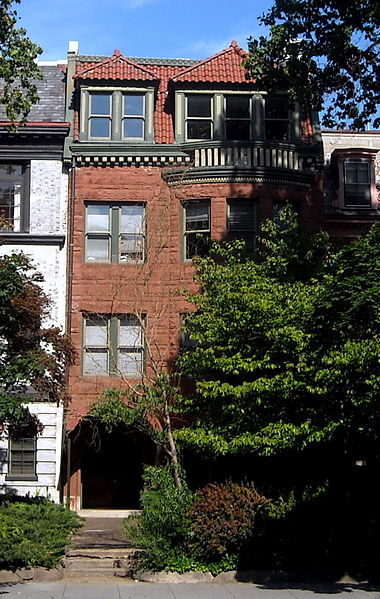
Robert Simpson Woodward House: This Washington home belonged to leading scientist Robert Woodward for twenty years.
From 1904 to 1924, late-19th century geologist and mathematician Robert Woodward lived in this rowhome. Woodward was well-respected in the science community and served as the first president of the…
Charlotte Forten Grimké House: This row house was the home of Charlotte Forten Grimké, a pioneering Black educator and civil rights activist.
Built circa 1875, this row house was the home of Charlotte Forten Grimké from 1881 to 1886. Grimké (1838-1914) was a pioneer Black female educator, an early supporter of women’s rights, a writer, and…
Meridian Hill Park (Malcolm X Park): This historic designed landscape stretches between the neighborhoods of Columbia Heights and Adams Morgan.
Meridian Hill Park, also known today as Malcolm X Park following a 1969 speech by activist Angela Davis, is a distinguished example of landscape design. The hilly, twelve-acre park with its Beaux-Arts…Tour curated by: DC Preservation League