National Historic Landmarks: African American History
Recognized for years as “Chocolate City,” and standing as the first major city in America to hold a majority Black population, the District of Columbia contains a wealth of African American history and culture.
From its early days as a slave-trading capital to its transition during the Civil War into a refuge for the formerly enslaved, Washington, D.C. has played a significant role in the African American freedom struggle. As the seat of the federal government, the District has witnessed the expansion (and restriction) of legal rights related to Black Americans. It has also been the home to major figures of African American history: Frederick Douglass, Charlotte Forten Grimke, Mary Ann Shadd Cary, Anthony Bowen, Mary Church Terrell, Blanche K. Bruce, Carter G. Woodson, Lucy Diggs Slowe, and Mary Burrill. The city has functioned as a site of protest, activism, and community organizing that has extended from early abolitionist efforts into modern movements for police reform through the Black Lives Matter Protests of 2020.
While no tour could possibly encompass the entirety of D.C.’s African American history, the followings sites are designated as National Historic Landmarks (NHLs) and have been deemed notable for their significance to the nation’s history. Consider how these sites connect to the story of America, and what nationally-significant sites along the way may be missing. This tour can be completed by walking, public transport, or car. NOTE: the sites are clustered in Northwest Washington, except for the final two stops; therefore, it is advised to map out your route to determine distance before beginning.
NHLs are ultimately designated by the Secretary of the Interior, upon the recommendation of the National Park System Advisory Board, and are evaluated based on their history, integrity of the property, and their value to the broader American historical narrative. There are currently around 2,600 NHLs, with 78 in the District alone.
Sites 12

Charlotte Forten Grimké House: This row house was the home of Charlotte Forten Grimké, a pioneering Black educator and civil rights activist.
Built circa 1875, this row house was the home of Charlotte Forten Grimké from 1881 to 1886. Grimké (1838-1914) was a pioneer Black female educator, an early supporter of women’s rights, a writer, and…
Mary Ann Shadd Cary House: This two-story brick rowhouse was the home of journalist and activist Mary Ann Shadd Cary from 1881 to 1885.
From 1881 to 1885, this was the home of Mary Ann Shadd Cary (1823-1893), who was a writer, journalist, educator, abolitionist, and lawyer. She is generally regarded as the first Black female…
General Oliver Otis Howard House: Built in 1867, this building is the sole survivor of the four original structures that comprised early Howard University.
The General Oliver Otis Howard House (1830-1909), today known as Howard Hall, was one of four early campus buildings at Howard University and the only one to survive to the present. Built in 1867, it…
Howard University: This Historic District and National Historic Landmark encompasses three significant buildings on the Main Yard.
These three buildings on Howard University’s Main Yard are nationally significant as the setting for the institution’s role in the legal establishment of racially desegregated public education, and…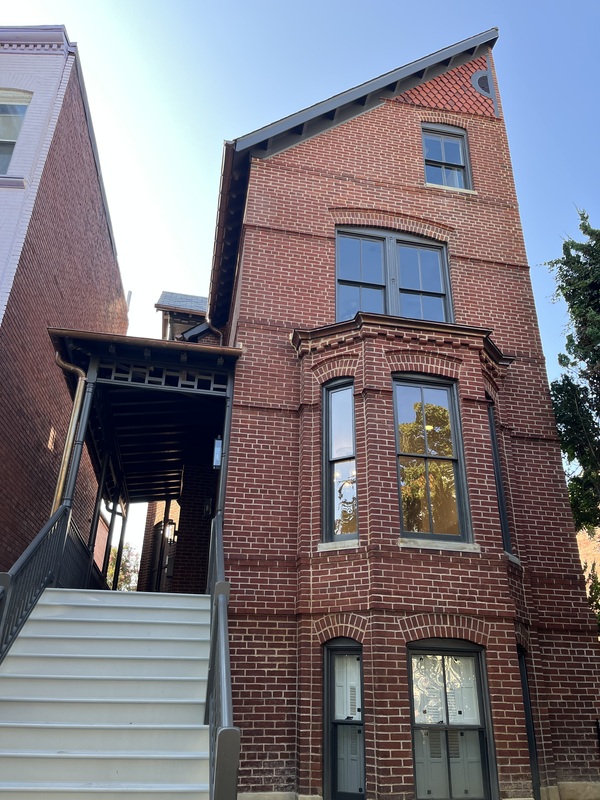
Mary Church Terrell House: This was the home of distinguished civil rights activist, suffragist, and educator Mary Church Terrell, who served as the first president of the National Association of Colored Women.
Mary Church Terrell (1863-1954) earned her Bachelor’s and Master’s degrees at Oberlin College during the 1880s and taught in Ohio and Washington, DC. Following the completion of her graduate degree,…
Anthony Bowen YMCA (Twelfth Street YMCA): This was the first full-service metropolitan building erected for the African American YMCA, and one of the oldest of a remaining handful of locations.
The Anthony Bowen YMCA is home to the nation's first African American chapter of the Young Men's Christian Association. The building is four stories and reflects the Italian Renaissance Revival style.…
Carter G. Woodson House National Historic Site: For more than forty years, the preeminent educator, publisher, and historian Carter G. Woodson lived and worked in this DC brick rowhouse.
At a time of Jim Crow ideology and enforced segregation, Carter G. Woodson (1875-1950) pioneered the documentation of African American life and the recognition of African American contributions to US…
Blanche K. Bruce House: Blanche K. Bruce, the only formerly enslaved man to serve in the Senate and the first Black man to serve a full term, lived in this house while a Senator.
Born into slavery in Prince Edward County, Virginia, Blanche Kelso Bruce (1841-1898) gained his freedom through the Emancipation Proclamation in 1863. He dedicated much of the rest of his life to…
Saint Luke’s Episcopal Church: Saint Luke’s was the city’s first independent Black Episcopal Church, established in 1879 by Reverend Alexander Crummell.
Built between 1876 and 1879, Saint Luke’s is a major work of Calvin T.S. Brent (1854-1899), the city’s first Black architect. It is designed in the early English Gothic style (Gothic Revival) and…
Lucy Diggs Slowe and Mary Burrill House: Lucy Diggs Slowe and Mary Powell Burrill lived here as a couple for 15 years.
This cross-gabled Queen Anne frame house at 1256 Kearny Street NE was built for prosperous Irish immigrants James T. and Hannah Ward. The house was probably completed in 1893, and the couple remained…
National Training School for Women and Girls
Founded in 1909, the National Training School for Women and Girls educated Black women from around the world. Unlike other prominent Black schools, such as the Tuskegee Institute, the founders did not…
John Philip Sousa Junior High School: This middle school stands as the epicenter of a critical battle in desegregating public education.
John Philip Sousa Junior High (now Middle) School, built in 1950, stands as a symbol of the lengthy conflict over the desegregation of public schools and the beginning of the modern civil rights…Tour curated by: DC Preservation League