Looking Back at the Joint Committee on Landmarks: A Selection of Sites
In 1978, the DC Council passed the Historic Landmark and Historic District Protection Act. This law established the current process of design review and historic designation, with landmarks and districts designated by the Historic Preservation Review Board (HPRB) and added to the DC Inventory of Historic Sites. However, Washington, DC has a rich historic preservation tradition that predates this law.
In 1950, the Old Georgetown Act was passed by the US Congress. This law created the District's first historic district. To this day, projects in the Georgetown Historic District are reviewed by the Old Georgetown Board, in conjunction with the U.S. Commission of Fine Arts - as opposed to the HPRB, which reviews projects in DC's other historic districts.
As historic preservation activism grew, both locally and nationally, a major turning point occurred in 1964. That year, the Commission of Fine Arts and the National Capital Planning Commission created the Joint Committee on Landmarks (JCL). The JCL was ordered to "compile and maintain a current inventory of significant landmarks in the District of Columbia and on Federal property in the remainder of the National Capital Region." Additionally, the JCL acted in an advisory capacity and would "serve as the District of Columbia's professional review committee to review all nominations to the National Register."
While largely honorary, the list, which eventually comprised over 300 historic landmarks and districts, was DC's first official inventory of historic structures and places. Many of these landmarks have since been added to the National Register, and some are also National Historic Landmarks. The list is also unique in that it ranks landmarks by their level of "importance" and "value," from the highest (Category I Landmarks) to the lowest (Category III Landmarks). For example, less than 30 landmarks were listed as Category I. This classification included many of the District's most famous historic sites, including the White House and Rock Creek Park.
Looking back at this inventory – over 50 years later – it is obvious that the list is not representative of the District's diverse history, culture, and architecture. The JCL focused on high-style architecture, and a limited number of historic events and figures. It is also limited in its geographic representation, as many of the sites are in the "Monumental Core" surrounding the National Mall, and in Georgetown. Today, the field of historic preservation strives to be more inclusive of underrepresented individuals and communities. There are many important historic narratives that would not have been considered by the JCL in 1964. Thankfully, many properties and their stories are now being formally recognized and designated, and the DC Preservation League is actively involved in this effort.
Nonetheless, this inventory was established at a time when historic preservation was growing in importance, and laid the groundwork for future historic preservation efforts in the District. This tour includes some of the landmarks considered significant by the JCL in the 1960s and 1970s.
For a comprehensive list of JCL sites, please see this link (https://www.loc.gov/item/75690024/) or search "joint committee on landmarks" on this website.
Sites 15

Volta Bureau and Laboratory (Alexander Graham Bell Laboratory; Bell Carriage House): During Alexander Graham Bell’s years in DC, the Volta Bureau and Laboratory served as his offices.
When Alexander Graham Bell received his first telephone patent in 1876, the device was still something of a curiosity. Within two years, though, the first telephone exchanges were opening as the…
Georgetown Custom House and Post Office: This historic Custom House is an important building in Georgetown and the District's history.
The Georgetown Custom House and Post Office, designed by Ammi B. Young and built between 1857 and 1858, is one of several standardized types of custom houses developed under Young's supervision. The…
Federal Reserve Board Building: This structure set the tone for progressive architecture in Washington, DC.
In 1935, the Federal Reserve Board held a national competition to select an architect who would design their new Washington, DC headquarters. The ultimate winner was the prominent Paul Philippe Cret,…
Winder Building: The Winder Building was technologically advanced at the time it was built for government use, prior to the Civil War.
At the time of its construction in 1847-1848, the Winder Building was notable for its height (which was much criticized in pre-elevator days), its early use of iron beams, and its central heating…
Martha Tucker House & George Hewitt Myers House (Former Textile Museum): The Textile Museum relocated to The George Washington University campus in 2015, and these houses are once again private residences.
This lot in Kalorama was vacant until 1908, when Martha S. Tucker built her house at 2320 S Street NW, designed by Wood, Donn and Deming. The firm, founded in 1902, designed a number of important…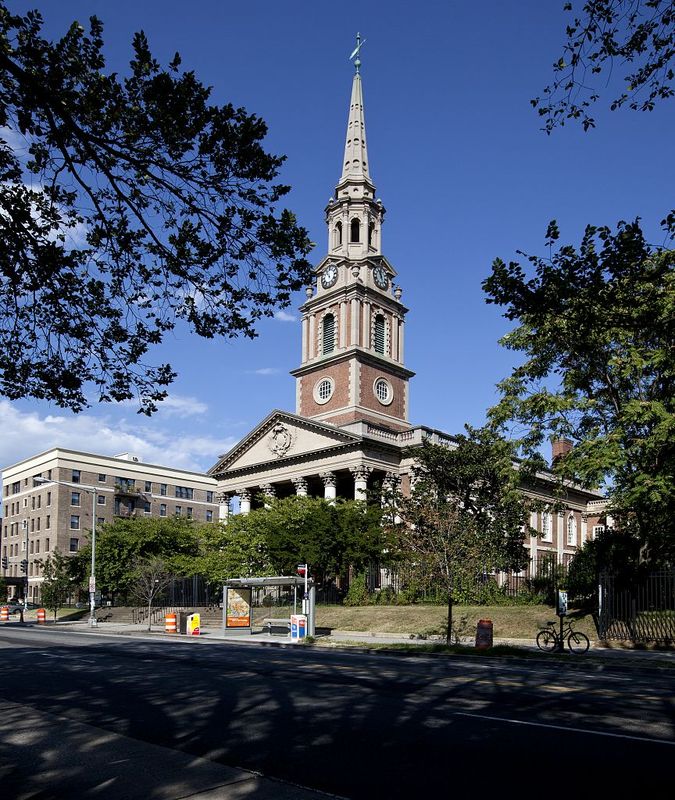
All Souls Unitarian Church: The All Souls Unitarian congregation dedicated its third and current church at Sixteenth and Harvard Streets NW in 1924.
In 1821, the congregation of All Souls Unitarian Church first organized as the First Unitarian Church. The original edifice stood at Sixth and D Streets NW; however, in 1877, the congregation erected…
Howard Theatre: Built in 1910, the Howard Theatre remains an important site for Black talent and entertainment.
Built in 1910, the Howard Theatre is one of the oldest theaters in the country that not only served Black audiences but provided a space for Black performers. For more than five decades of the…
Luther Place Memorial Church and Luther Statue: With a statue of Martin Luther, Luther Place is a distinctive Gothic Revival church and a notable example of post-Civil War architecture.
Formally known as Memorial Evangelical Lutheran Church, Luther Place Memorial Church was founded in 1873 as a memorial to peace and reconciliation following the Civil War; two of the original pews…
Central National Bank (Apex Building): The Apex Building showcases changes to Pennsylvania Avenue from the nineteenth century through today.
The Central National Bank, also known as the Dorothy I. Height Building or Apex Building, is now the national headquarters of the National Council of Negro Women. The twin-turreted, former bank was…
Arts and Industries Building: Constructed between 1879 and 1881, this is the nation’s best-preserved example of nineteenth-century world’s fair architecture.
Designed by Cluss & Schulze and built to house the international exhibits left over from the Philadelphia Centennial Exhibition of 1876, the Smithsonian Institution's Arts and Industries Building…
The United States Capitol: The centerpiece of the Federal City crowns the hill L’Enfant described as “a pedestal waiting for a monument.”
The Capitol is both the seat of government and the symbol of the United States. It has been occupied continuously by Congress since 1800 (excepting one brief interruption), and until 1935 it housed…
Christ Church, Washington Parish (Christ Church Navy Yard): Incorporated in 1794, Christ Church was the City's first Episcopal parish.
The first section of Christ Church was built in 1806-1807. Designed by architect Robert Alexander (but attributed to Benjamin Latrobe), the structure features a battlement facade, possibly copied from…
Gallaudet College Historic District: The Gallaudet College Historic District includes most of the original campus of the only university in the U.S. dedicated to the education of the deaf.
Gallaudet University, founded in 1864 as the National Deaf-Mute College, has been since its inception the only institution of higher learning in the United States devoted specifically to the education…
Civil War Fort Sites and Fort Circle Park Historic District: These sites constitute some 1,300 acres of federal park land and compose a valuable cultural resource.
As the seat of the Union at the intersection of the North and the South, Washington D.C. played a pivotal role in the Civil War. Throughout the progression of the conflict, D.C. constructed numerous…
Frederick Douglass National Historic Site: The legacy of abolitionist and civil rights activist Frederick Douglass is preserved at his former residence in Anacostia.
"The American people have this lesson to learn: that where justice is denied, where poverty is enforced, where ignorance prevails, and where any one class is made to feel that society is an organized conspiracy to oppress, rob, and degrade them, neither persons or property will be safe." Frederick Douglass in a speech commemorating the 24th anniversary of emancipation in Washington DC ("Southern Barbarism")Tour curated by: DC Preservation League