Historic Farms and Estates of Washington County
This tour explores the historic farms and estates located within former Washington County — an area outside of the original City of Washington and Georgetown (i.e., generally north of Boundary Street, now Florida Avenue, and east of the Anacostia River). Washington County, Washington City, and Georgetown were consolidated in 1871, and comprise the entirety of modern DC. Today, through these historic landmarks, remnants of a previously pastoral way of life can still be found within the bounds of the District.
This tour includes historic farmhouses, estates, mills, barns, and springhouses, as well as archaeological sites. Two of the most notable landmarks from this collection are Lincoln’s Cottage and Frederick Douglass National Historic Site. Built in 1842 in a wooded area north of the city, Lincoln's Cottage was originally constructed as a summer retreat for prominent banker George Washington Riggs. From 1862 to 1864, the cottage served as President Lincoln’s summer home and is most famous as the place where Lincoln authored the Emancipation Proclamation. The following decade, in 1877, Frederick Douglass purchased Cedar Hill, a hilltop residence in Anacostia that overlooks the city. Today, both historic house museums can be visited.
Another well-known rural landmark is Peirce Mill, located within Rock Creek Park at Tilden Street and Beach Drive NW. Peirce Mill was built in 1829 and was used for grinding corn, wheat, and rye. The mill was in service until 1897, when its turbine shaft broke. It is also important to note that the mill was part of the larger Peirce Plantation, which also included a springhouse and barn that you can still see today. The plantation and its owner, Isaac Peirce, relied on enslaved labor throughout the early 1800s, as DC did not abolish slavery until 1862. Thus, several of these agricultural and rural landmarks were sites of enslavement, including Kalorama Park, the former location of the John Little House.
Over time, as the city expanded north and east, these rural farms and estates were surrounded by new residential subdivisions, and most of the rural landscape was lost. However, these extant buildings and structures are a reminder of DC’s lost agricultural landscape. They are no longer country homes, estates, and farms surrounded by fields of crops, wooded forests, and rolling hills. Instead, these sites have been incorporated into the modern layout and built environment of the city, and sometimes you have to look closely within a neighborhood to notice these landmarks. Many of these landmarks have new uses, such as The Highlands and Woodley Mansion, which have been incorporated into private school campuses, and Ingleside, which serves as a nursing home.
This tour can be completed by walking, public transport, and/or car. Since the landmarks are spread out, it is advised that you map out your route to determine distance before beginning.
*This tour is based on “Lost Farms and Estates of Washington, D.C.” by Kim Prothro Williams.
Sites 29

African American Rural Home Sites in Washington DC, 1865-1900: Three sites located in Rock Creek Park mark a historic settlement of African Americans following the Civil War.
Three sites located in Rock Creek Park mark a historic settlement of African Americans following the Civil War. Washington, DC, was established as a slave-holding district in 1790. Prior to its…
Brooks Mansion: Brooks Mansion and its grounds are a Brookland landmark, occupying an entire square in the neighborhood.
Brooks Mansion is a Greek Revival-style plantation house built by wealthy landowners Ann and Jehiel Brooks around 1840. A large eastern addition to this house was built by the Marist Society, which…
Cloverdale (Pierce Shoemaker House): Cloverdale, also known as the Pierce Shoemaker House, was built around 1810 in a prestigious residential area of the city.
Built around 1810, Cloverdale and its outbuildings are significant as an example of a large, suburban residential complex in early residential DC. The site has historical associations with Isaac…
Dent Springhouse: This simple structure from about 1845 is a rare example of a once common and necessary part of rural life.
This springhouse was constructed about 1845, when the Springland farmhouse, for which it served as an outbuilding, was built. At the time, such a building was a necessity of rural life—a springhouse…
Frederick Douglass National Historic Site: The legacy of abolitionist and civil rights activist Frederick Douglass is preserved at his former residence in Anacostia.
"The American people have this lesson to learn: that where justice is denied, where poverty is enforced, where ignorance prevails, and where any one class is made to feel that society is an organized conspiracy to oppress, rob, and degrade them, neither persons or property will be safe." Frederick Douglass in a speech commemorating the 24th anniversary of emancipation in Washington DC ("Southern Barbarism")
Gallaudet University, President’s House: This large, red brick high Victorian Gothic Revival house is located on a knoll on the Gallaudet campus.
The President's House, erected between 1867 and 1868 and designed by F.C. Withers, is separated from a row of three High Victorian Gothic Revival Professors' Houses by a circular drive and from the…
General Oliver Otis Howard House: Built in 1867, this building is the sole survivor of the four original structures that comprised early Howard University.
The General Oliver Otis Howard House (1830-1909), today known as Howard Hall, was one of four early campus buildings at Howard University and the only one to survive to the present. Built in 1867, it…
George M. Lightfoot House: The Lightfoot House is a rare survivor of a rural Brightwood community once characterized by summer and weekend estates and manors.
The George M. Lightfoot House was built as a residence in 1892 for Frederick Bex, a carriage maker in the small crossroads village of Brightwood in what was then still referred to as Washington County…
Grant Road Historic District: The Grant Road Historic District encompasses a distinctive remnant of the settlement that once stretched out along the country roads crisscrossing Washington County.
The Grant Road Historic District consists of a two-block remnant of a major east-west connector road that historically led from Tenleytown (formerly Tenallytown), on the important Frederick Road…
Harewood Lodge: Harewood Lodge is the last standing structure from the four DC farms or estates of prominent Washington banker and philanthropist, William Wilson Corcoran, and one of a few remaining from his considerable real estate holdings throughout the District.
Constructed in 1857, Harewood Lodge was the porter’s lodge for the country estate and farm of American banker, William Wilson Corcoran (1798-1888) in rural Washington County. The building served a…
The Highlands (Sidwell Friends School): This Georgian-style country house, now part of Sidwell Friends School, has been home to several significant Washingtonians.
Erected between 1817 and 1827 by the first United States Register of the Treasury, Joseph Nourse (1754-1841), The Highlands is a late-Georgian styled home. The Nourse family, who owned and lived in…
Ingleside (Stoddard Baptist Home): Originally designed by Thomas Ustick Walter, this house is an important example of his domestic design.
The Stoddard Baptist Home, known historically as Ingleside, is a skillful example of the Italian Villa style of residential architectgure. Built in the early 1850s, Ingleside has had a distinguished…
Jackson Hill (Holt House): Built by 1827, Holt House is one of the few remaining houses in Washington to feature a five-part Georgian plan.
Over the years, Holt House has come to be associated with Presidents John Quincy Adams, Andrew Jackson, and Martin Van Buren, but no substantial evidence has been uncovered to support these claims.…
Jost-Kuhn House: This Italianate style residence dates to 1859, when this area was rural Washington County.
Located in the Brightwood neighborhood, the Jost-Kuhn House was constructed in 1859 on a 24-acre tract. The Jost-Kuhn House is a two-story brick house and is an excellent and intact example of a…
Kalorama Park and Archaeological Site: This park in Kalorama also includes an archaeological site commemorated as part of the Underground Railroad.
The three-acre Kalorama Park contains the Kalorama Playground Archaeological Site, also known as the John Little House. The site represents the remains of John Little’s home and farm and is the place…
Lincoln Cottage (President Lincoln and Soldiers’ Home National Monument): Located within the Armed Forces Retirement Home Historic District and Soldiers' Home National Historic Site, the Gothic Revival-style cottage was originally known as Corn Rigs.
The Gothic Revival summer cottage of banker George Washington Riggs was constructed by carpenter William Degges in 1842-43 -- according to plans by Philadelphia architect John Skirving, a close…
Linnaean Hill (Joshua Pierce House; Pierce-Klingle Mansion): The Pierce-Klingle Mansion was built in 1823 by Joshua Pierce, who used the fertile grounds for horticulture.
Linnaean Hill, built in 1823 by Joshua Pierce, was named in honor of the Swedish botanist Karl Van Linnaeus as the surrounding area was so conducive to the raising and growing of shrubs and flowers.…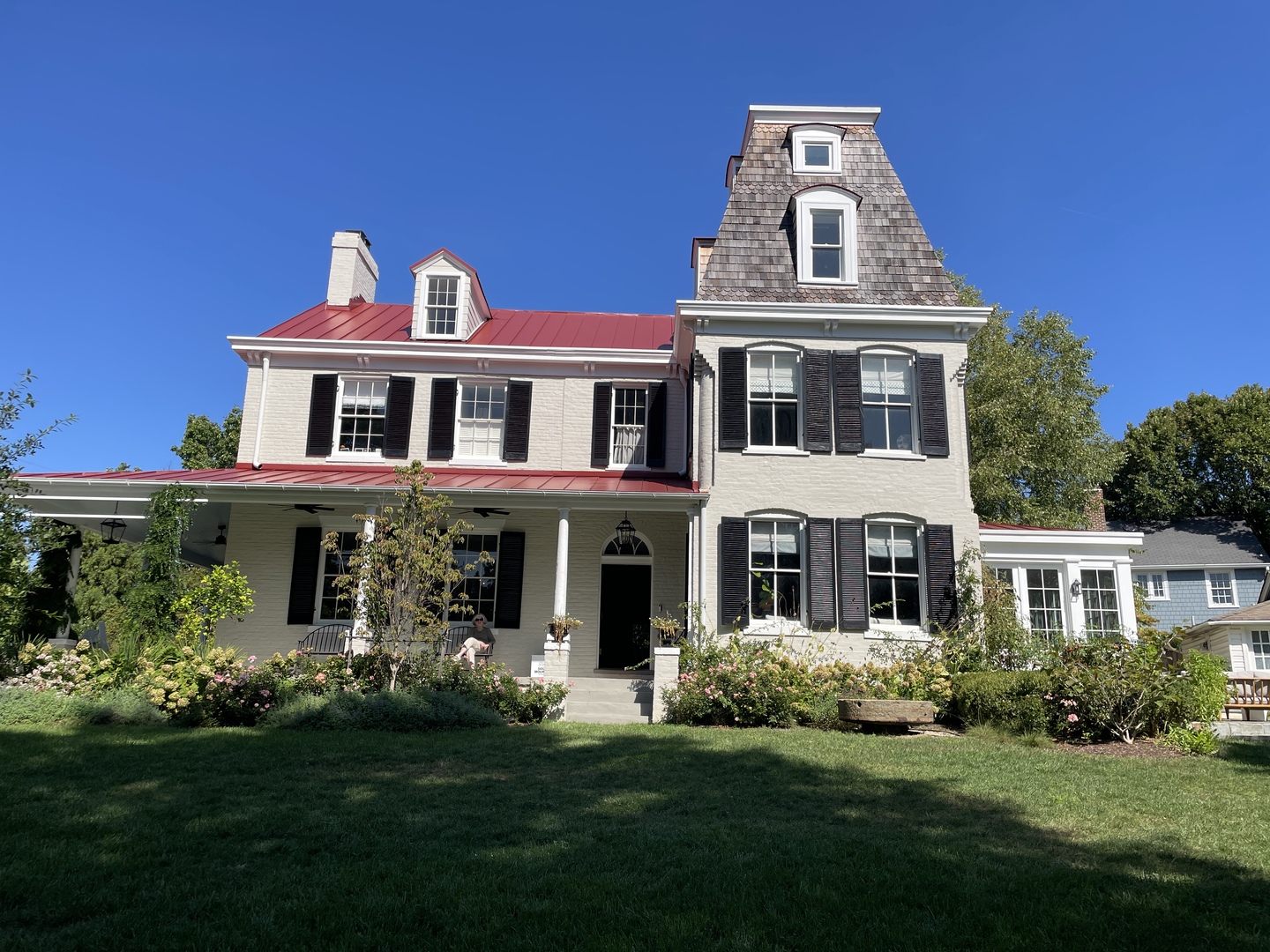
The Rest (Lyles-Magruder House): Also known as the Lyles-Magruder House, this estate is the oldest extant building in Tenleytown.
The Rest, also known as the Lyles-Magruder House, was once a part of Mrs. Magruder’s great estate. The Tenleytown residence has incredible historical significance over three centuries, as it held many…
Owl’s Nest: This historic Shingle-style home stands as a reminder of Washington's surroundings before suburban development.
Built as a rural country house for journalist William L. Crounse, Owl’s Nest and its exceptional wooded grounds illustrate the gradual transition of the former Washington County from farmsteads, to…
Peirce Mill: Peirce Mill is the principal relic of the Peirce plantation and a unique symbol of the milling industry that once flourished along Rock Creek.
Built in 1829 by slaveholder Isaac Peirce, the Peirce Mill on Rock Creek ground corn, wheat, and rye until 1897, when its turbine's shaft finally broke. The mill was situated on a 960-acre plantation,…
Pierce Springhouse and Barn: The Pierce Springhouse and Barn, also known as the Art Barn, is an historic barn and springhouse in Rock Creek Park.
The Pierce Springhouse, located in Rock Creek Park on the green median strip between the dual lanes of Tilden Street, NW, is constructed of blue granite that was quarried locally at a nearby Broad…
Rosedale (Uriah Forrest House): This 18th-century Cleveland Park residence has managed to retain the feeling of a rural farmhouse.
Located on a hill in Cleveland Park, Rosedale is an 18th-century frame house that stands on spacious grounds surrounded by trees and boxwood. Despite being located within Washington's boundaries, the…
Samuel and Harriet America Burrows House: This farmhouse is a remnant of pre-development Tenleytown.
Constructed circa 1850, the Samuel and Harriet America Burrows House is one of four in the American University Park neighborhood known to have existed before the area was platted for residential…
Scheele-Brown Farmhouse: The Scheele-Brown Farmhouse is a rare extant reminder of small-scale farming and butchering activities in early DC.
The Scheele-Brown Farmhouse, named for the first two families that occupied the building and the only residents who farmed the surrounding land while living there, was constructed in the latter half…
Springland (Henry Hatch Dent House): This brick house is one of a very few antebellum structures remaining in the former Washington County.
The Springland house, built circa 1845, is positioned on a hill surrounded by numerous mature trees on just under an acre of land, which slopes down to the entrance to the house on the north and away…
Van View: Built between 1868 and 1871, this Second Empire country house was once part of a large working farm.
The stately Second Empire style country house constructed between 1868 and 1871 and known as Van View occupies an almost half-acre corner lot at 13th and Jonquil Streets. It is generally surrounded by…
Wetzell-Archbold Farmstead (Anne Archbold Cabin): This one-acre farmstead features the earliest known log dwelling in Washington.
Located on a wooded one-acre knoll above Glover-Archbold Park, the Wetzell-Archbold Farmstead contains a ca. 1843 log dwelling with log and frame additions, the earliest known such dwelling in the…
Whitehaven (Thomas Main House): On Reservoir Road stands this one-time manor house constructed in the early 19th-century.
Beautifully restored by Dr. and Mrs. E. Stuart Lyddane, it is believed that this house was built sometime around 1805. The Carberry family once lived here, and later built the original house of the…
Woodley Mansion (Maret School): The Federal-style Woodley Mansion currently hosts the Maret School, but its residents since 1801 have included presidents and statesmen.
Built in 1801 by Philip Barton Key, the Federal-style Woodley Mansion is notable for its many brushes with figures instrumental in American history. Key, himself the uncle of "Star-Spangled Banner"…Tour curated by: DC Preservation League