National Archives Building: The National Archives serves as the repository of the most valuable and rare paper documents of the United States, such as the Declaration of Independence and the US Constitution.
Text
Throughout the nineteenth and early twentieth centuries, US government agencies and branches were responsible for maintaining their own documents, often resulting in the loss and destruction of records. In 1934, Congress created the National Archives to centralize federal record keeping, and appointed Robert D. W. Connor (1878-1950) as the first Archivist of the United States. While independent from the US government, the National Archives preserves historical documents and government records. The National Archives also maintains and publishes legally authentic and authoritative copies of acts of Congress, presidential directives, and federal regulations, as well as Electoral College votes. Additionally, the National Archives maintains public access to those records including the Constitution, the Bill of Rights, and the Declaration of Independence. Researchers can also view documents in the Research Room that are not on display. The seventh building to be constructed in the Federal Triangle from 1931 to 1937, the National Archives Building is a monumental structure designed in the twentieth century neoclassical manner by John Russell Pope (1874-1937). The Archives Building occupies a dominant position in the Federal Triangle. DC Inventory: November 8, 1964 (Joint Committee on Landmarks)National Register: May 27, 1971National Historic Landmark: December 11, 2023
Files

The nation's founding documents displayed under subdued light at the National Archives, Washington, D.C., [between 1980 and 2006]
Highsmith, Carol M, photographer. The nation's founding documents displayed under subdued light at the National Archives, Washington, D.C. [Between 1980 and 2006] Image. Retrieved from the Library of Congress, https://www.loc.gov/item/2011633881/. (Accessed September 27, 2016.)
National Archives, main facade on Constitution Avenue and 7th Street facade, circa 1971

[National Archives Building, Washington, D.C.], 1935
Harris & Ewing, photographer. [National Archives Building, Washington, D.C]. [1935] Image. Retrieved from the Library of Congress, https://www.loc.gov/item/hec2013008759/. (Accessed September 27, 2016.)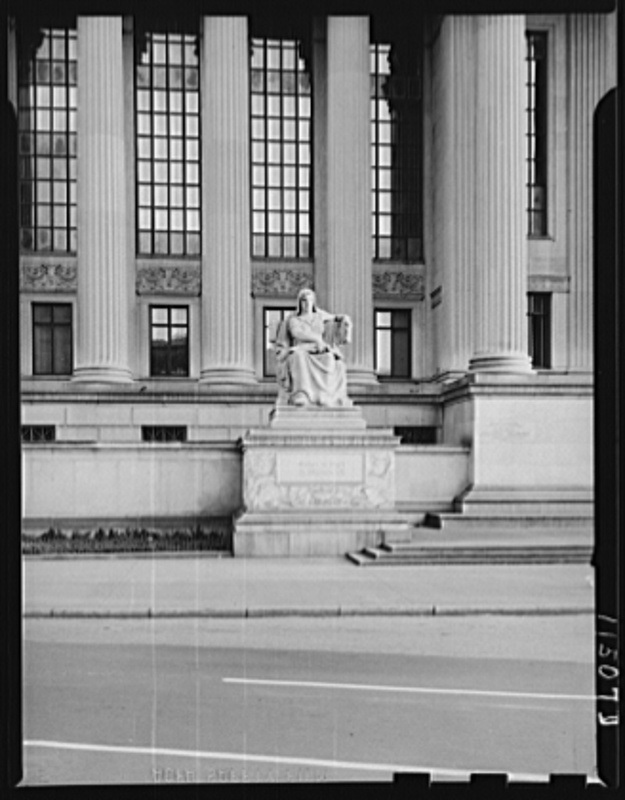
Washington, D.C. Statue on the Pennsylvania Avenue entrance to the National Archives of the United States. The inscription reads: "What is past is prologue," May 1942
Ferrell, John, photographer. Washington, D.C. Statue on the Pennsylania Avenue entrance to the National Archives of the United States The inscription reads: "What is past is prologue". May, 1942. Image. Retrieved from the Library of Congress, https://www.loc.gov/item/fsa1998022954/PP/. (Accessed September 27, 2016.)
What is Past is Prologue
Date: March 11, 2019