2021 Landmarks in Review
2021 was another successful year for historic preservation in DC. In February, Colony Hill became the District’s 37th neighborhood historic district (with its own design guidelines), while in October, the long-standing Anacostia Historic District was expanded for the first time since its designation in 1978. The Anacostia Historic District Boundary Expansion was submitted by DCPL, Historic Anacostia Block Association, and Historic Anacostia Preservation Society.
The DCPL and owner-submitted landmark nomination for the Bazelon-McGovern House, a Mid-Century Modern home with Japanese stylistic elements in the Palisades, was approved in February. In September, two DCPL initiatives were considered and approved by the HPRB. The African American Civil Rights Multiple Property Document was adopted, and Lucy Diggs Slowe Elementary School in Brookland was historically designated. Throughout the year, these other properties were also officially added to DC’s Inventory of Historic Sites: Thomas Jefferson Junior High School (January), Episcopal Home for Children (February), Southeast Branch Library (March), Twelfth Precinct Station House (May), Coolidge High School (September), and The Hampshire Apartments (December).
Sites 10

Anacostia Historic District
Initially incorporated under the name Union Town, Anacostia began as a working-class community removed from the city and dominated by Navy Yard employees. In the latter half of the nineteenth century,…
Southeast Branch Library: Since its opening on December 8, 1922, the Southeast Branch Library has diligently served Capitol Hill through their extensive collection of books, beloved children’s programs, and commitment to community engagement.
In 1921, Congress approved $10,000 of funding for the construction of the Southeast Branch Library. With the additional support of Andrew Carnegie’s monetary donation, the Southeast Branch Library was…
Thomas Jefferson Junior High School: Thomas Jefferson Junior High School marks a significant period in the nation’s history of educational evolution and stands as an outstanding architectural example of the Georgian Revival Style.
Designed by Nathan C. Wyeth, Thomas Jefferson Junior High School’s exemplary Georgian Revival Style is evidenced through architectural symmetry, a cupola over the main block, and a two-story entry…
Colony Hill Historic District: Colony Hill represents an outstanding example of a twentieth century planned community in Washington, D.C. with many Colonial Revival style homes.
In the 1930s, Colony Hill – near Reservoir and Foxhall roads – emerged as a distinctive suburban development built in an architectural style that echoed the Georgian and Federal styles of the early…
Bazelon-McGovern House: Constructed in 1957, the Bazelon McGovern House is historically significant not only as a home to two notable politicians, but as a symbol of larger trends in American art and architecture in the post-World War II era.
“Japanese architecture is a thoughtful meandering along a keyboard. Each note struck is another column; the intervals of silence are the spaces they delimit. Crescendos are rare, the art of the fugue is unknown, and to the Western observer there seems to be no reason why this architectural 'music' cannot continue forever across the landscape.” Arthur Dexter, MOMA Exhibition Catalogue
Episcopal Home for Children: For 125 years, the Episcopal Home for Children offered a range of services for underprivileged children in Washington, DC.
“It was becoming clear that many of the so-called advances of industrial society were achieved at the expense of children’s health and well-being…” Children’s Bureau, U.S. Department of Health and Human Services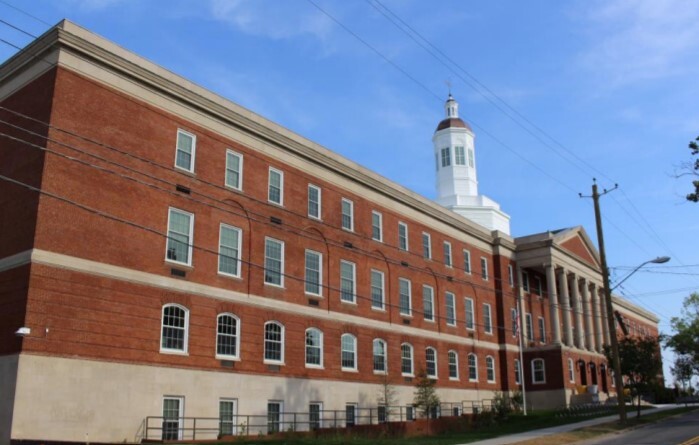
Calvin Coolidge Senior High School: Constructed between 1937 and 1940, Calvin Coolidge Senior High School stands as one of the last schools built under DC’s Five-Year Building Plan.
Designed by Nathan C. Wyeth, Calvin Coolidge Senior High School (Coolidge High School) constitutes a significant example of Georgian Revival architecture in the District—and remains part of the…
The Hampshire Apartments: Constructed between 1935 and 1936, the Hampshire Apartments are representative of interwar construction in America’s urban landscape.
Designed by local D.C. architect Louis T. Rouleau, these two buildings reflect the development of residential units on New Hampshire Avenue following World War I. Modest in appearance and created for…
Lucy Diggs Slowe Elementary School: Constructed during the fight for educational equality, the Lucy Diggs Slowe Elementary School stands as a symbol of civil rights activism in Brookland.
“Must we allow this nonsensical custom of segregation to deny our children adequate educational facilities while enrollment for schools of the other race is hardly sufficient for maintenance?” O.V. Maedel, “Slowe School Overcrowding,” letter to the editor, Evening Star, Nov. 4, 1950.
12th Precinct Station House: The Twelfth Precinct Station House stands as one of seven remaining buildings constructed in the early 20th century as purpose-built police stations in the District.
Constructed in the 1920s, the 12th Precinct Station House is architecturally significant as a prominent example of the Colonial Revival style in the District. Additionally, the station house is…Tour curated by: DC Preservation League