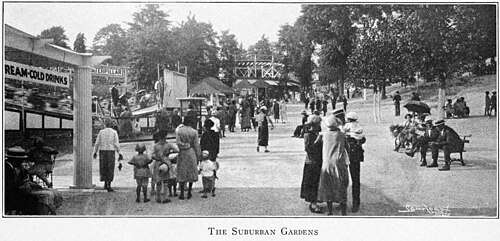
Sports and Recreation Tour: Suburban Gardens Amusement Park (1921-1932): At its peak, the park hosted over 20 concessionaires and featured a Miller & Baker roller coaster, a scenic railway, a Ferris wheel, a children’s playground, a dance pavilion, and picnic areas.
Text
Suburban Gardens Amusement Park opened in Northeast Washington, DC, on June 25, 1921. This park was created specifically for Black residents and exclusively employed Black workers at a time of racial segregation. Developed by the Universal Development and Loan Company and partially designed by local Black architect Lewis Giles, it covered approximately nine acres of land at the corner of 50th Street and Hayes Street NE in the Deanwood neighborhood.
At its peak, the park hosted over 20 concessionaires and featured a Miller & Baker roller coaster, a scenic railway, a Ferris wheel, a children’s playground, a dance pavilion, and picnic areas where visitors could relax and watch the festivities. When the park first opened, it was slow to attract crowds, as it initially offered only the dance pavilion, a single café, and a merry-go-round. However, within its first year, the park expanded and became the most popular space for Black residents seeking relaxation and entertainment.
In addition to the roller coaster, the park eventually included other newly invented rides such as the Caterpillar, the Whip, the Dodgem, and the Tumble Bug. The dance pavilion became a particularly popular attraction, opening at the height of the Jazz Age. The park featured performances by some of the city’s and the nation’s most well-known artists, with many shows including dance styles like the Charleston, the Lindy Hop, and the Black Bottom. Russell Wooding, a well-known DC musician who played in Broadway shows and worked with Duke Ellington, provided music for the park’s merry-go-round.
To further attract visitors, the park offered free band concerts, contests, children’s costume pageants, and stilt-walking clowns. In 1926, the park even hosted an aerial performance called the Marvelous Melville aerial act. These unique attractions drew visitors from across DC and the surrounding area, making the park a hub of Black entertainment for at least a decade.
However, the park did face some resistance from the city, which led to minor infrastructure issues. For example, the city refused to install improved street lighting near the park entrance, making it somewhat unsafe for visitors leaving after dark. In 1929, the park was purchased by Abe Lichtman’s company, which expanded the park briefly before closing it a few years later. The land was eventually converted into Federal Housing Administration apartments. For a short time, Suburban Gardens successfully met the needs of a community that had few options for safe, high-quality entertainment.
This site is a stop on the Sports and Recreation in DC tour. It is no longer extant and is not a desginated historic landmark.
Files